
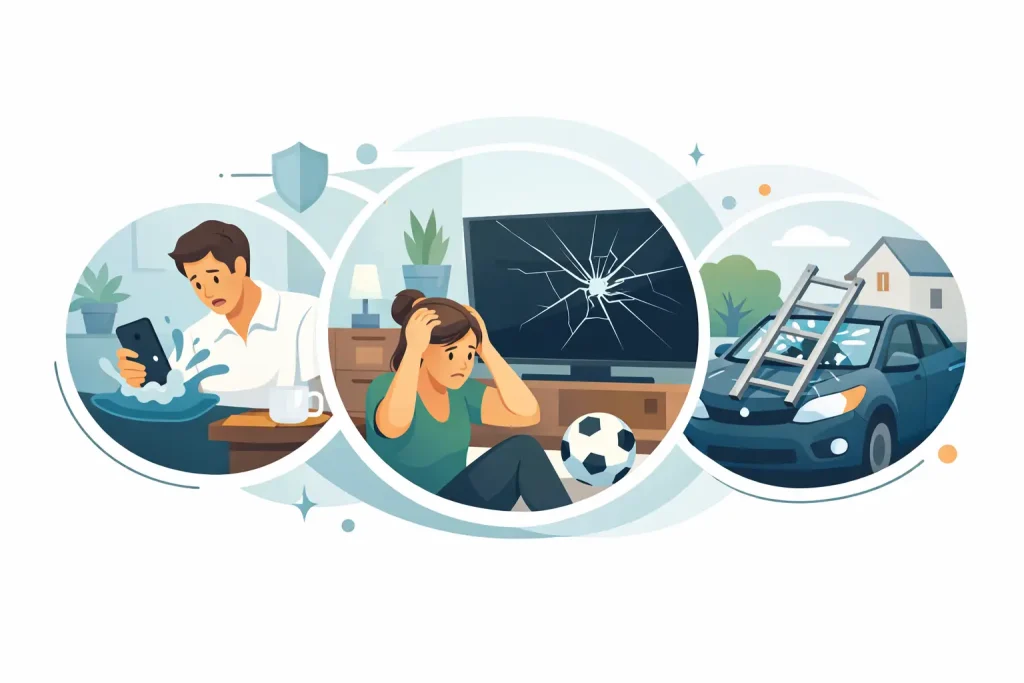
There is usually a moment, just before the policyholder phones in, when the room goes quiet and somebody says, “You’re not going to believe this.” That is why accidental damage insurance stories have such staying power. They begin with ordinary life – a mug of tea near a laptop, a football in the wrong garden, a ladder placed one rung too high – and then veer into expense, embarrassment and, occasionally, outright farce.
For anyone who has worked in claims, these stories are rarely just comic relief. They are small case studies in human behaviour. People are flustered, defensive, apologetic, sometimes creative with the truth and often genuinely baffled that such a simple thing could cost so much. For everyone outside the trade, they offer a sharp glimpse into what insurance work actually looks like when the paperwork lands on a desk and the facts begin to wobble.
Why accidental damage insurance stories matter
The phrase itself may sound like light entertainment, but the best accidental damage insurance stories do something more useful. They show how claims are judged in the grey area between bad luck, carelessness and something that was never quite accidental in the first place.
That distinction matters because accidental damage cover is often better understood in theory than in practice. Most people assume they know what counts. Then a child knocks over a television, a decorator spills paint through a stairwell, or a ring disappears while someone is gardening, and suddenly the neat definition falls apart. Was it sudden? Was it unintended? Was there a clear incident? Could it have been prevented? Those are the questions that turn a straightforward anecdote into a claim decision.
This is where stories outperform dry policy wording. A schedule may tell you what is included. A real incident tells you how people describe events, what evidence survives, and where common sense either rescues or ruins the claim.
The anatomy of a proper accident
The strongest claims usually have one thing in common – they sound exactly like real life. They are inconvenient, slightly humiliating and full of details nobody would invent because they make the claimant look foolish. A man carrying a mirror up a narrow landing misjudges the turn and sends it through a banister. A guest sits on an ornamental chair that was decorative rather than structural. A frozen chicken slips from a shopping bag onto a glass hob. Absurd, yes. Impossible, not at all.
Insurance professionals learn to listen for texture. Real accidents tend to come with untidy edges. Times are approximate. Reactions are human. There is often an immediate clean-up, a hurried phone call, or a failed attempt to make things better before anyone thinks about a claim. Fraud, by contrast, can be too polished. The story arrives ready-pressed, every detail aligned, every answer suspiciously prompt.
That does not mean genuine claimants are always consistent. Memory is a slippery thing, especially when people are stressed. Someone may say the vase fell at lunch, then later say early afternoon, and still be telling the truth. The job is not to expect courtroom perfection. It is to work out whether the core event makes sense.
When a good story becomes a bad claim
Many declined claims are not declined because the event obviously never happened. They fail because the claimant stretches the account a little too far, or because what they thought was covered turns out to be wear and tear, gradual damage or simple maintenance.
Take the householder who notices a stain on the ceiling after months of a tiny leak and describes it as an accident. From their point of view, it certainly feels accidental. They did not intend it, and the damage is real enough. But insurance is not a catch-all for everything unwelcome. Sudden and unforeseen is one thing. Slow deterioration is another.
Then there are the claims where embarrassment gets in the way. People dislike admitting they balanced a costly item precariously, ignored an obvious risk or let a lively dog loose near something fragile. So the story is tidied up. The polishing is often what undoes it.
What these stories say about people
Accidental damage claims reveal a great deal about the British character. We are, on the whole, quite inventive in the first five minutes after something has gone wrong. We mop, glue, prop, conceal and reassure. “It’ll be fine” has probably worsened more losses than malice ever did.
There is also a peculiar dignity in the way people report mishaps. Some are mortified and undersell the problem. Others become amateur barristers overnight, presenting an argument rather than a sequence of events. A few treat the claims handler as a confessor. By the end of the call, one knows far more than necessary about family dynamics, home improvements and why Uncle Dennis should not have been trusted with the chandelier.
That is partly why stories from this corner of the industry endure. They are not really about carpets, tablets, sideboards or spectacles. They are about judgment. They show how people react when value, blame and bad luck meet in the same room.
The claims lessons hidden inside accidental damage insurance stories
For industry readers, none of this is new, but it is a useful reminder that technical skill and human judgment are never far apart. Policy wording matters, certainly. So do reserves, evidence, endorsements and precedent. Yet a surprising amount of a claim turns on listening properly and noticing what does not fit.
A good adjuster or handler is not there to play the cynic in every case. Constant suspicion is as unhelpful as blind acceptance. The job is to test the account without bullying the claimant, to ask the obvious questions without sounding theatrical, and to distinguish between an honest muddle and a manufactured event.
For policyholders, the lesson is simpler. Tell the truth, even when it makes you look daft. Especially then. A ridiculous but honest accident is far more credible than a sensible story that has been overmanaged. Keep receipts if you have them. Photograph the damage before the clean-up if you can. And read the policy before disaster strikes, not after the dog has eaten the hearing aid.
Why the smallest incidents can become the most memorable
Catastrophic losses dominate headlines, but accidental damage often produces the stories people remember for years. Perhaps that is because the scale is domestic and recognisable. Most readers have not handled a factory blaze or a flood claim involving half a village. Nearly everyone, though, has broken something valuable, spilt something dreadful or heard the unmistakable crash that is immediately followed by silence.
Those are the moments that make insurance feel real. Not abstract transfer of risk, but the practical business of deciding what happened in a kitchen, on a driveway or halfway up the stairs. It is insurance at eye level.
That is also why this subject lends itself so well to memoir and anecdote. Behind every claim file sits a scene, and behind every scene is a person trying to explain how an ordinary day went slightly, expensively wrong. In the hands of someone who has spent decades around such cases, the result is more than trade gossip. It becomes a portrait of an industry and of the people who stumble through it.
The enduring appeal of accidental damage insurance stories
The appeal lies in the mixture of comedy and consequence. A smashed basin, scorched worktop or cracked antique can be funny in the retelling and costly in the moment. That tension gives the best stories their edge. We laugh because the incidents are recognisable. We keep reading because the financial and emotional stakes are real.
There is another reason these tales land so well. They strip insurance of its jargon without stripping out its complexity. You can understand a broken window instantly. Then, as the claim unfolds, you begin to see the layers beneath it – proximate cause, evidence, policy response, credibility, settlement. The story carries the lesson without making a lecture of it.
That is something Richard Thurstan’s world understands particularly well. The trade has always been full of marvellous stories, but they are rarely told with the blend of candour, mischief and professional insight they deserve. When they are, the reader gets both entertainment and a clearer picture of what claims work is really like.
And perhaps that is the most useful thing these stories offer. They remind us that insurance is not merely about damaged objects. It is about the untidy business of sorting fact from assumption, accident from excuse, and fair outcomes from hopeful exaggeration. If a tale happens to involve a collapsing bookcase, a panicked policyholder and an extremely unfortunate pot of gloss paint, so much the better.
The next time you hear somebody begin with, “This sounds absurd, but it really did happen,” it is worth paying attention. In insurance, that is often exactly where the truth starts.
One Response