
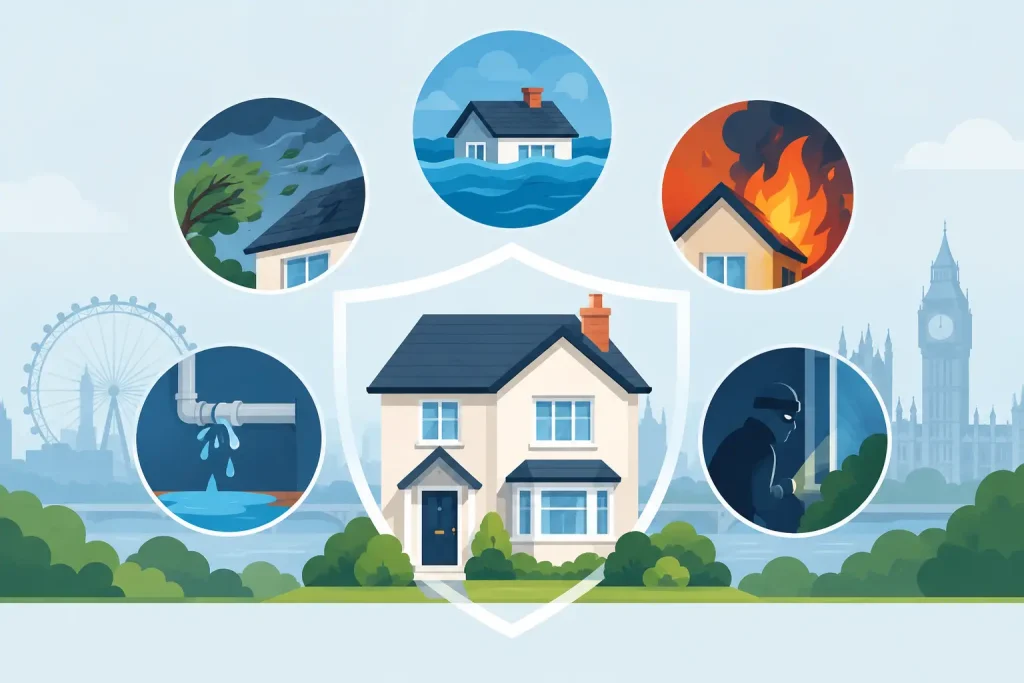
A flooded kitchen rarely begins with a dramatic burst pipe worthy of the evening news. More often, it starts with a washing-machine hose quietly failing behind a cupboard while everyone is at work. That is the trouble with unexpected causes of property loss: the most expensive incidents are frequently caused by ordinary things nobody thought to inspect.
After decades around claims, one pattern becomes rather clear. Property does not always announce its intention to misbehave. A roof leak can look like a small brown mark until it has ruined plaster, electrics and furniture. A tenant can leave a window on the latch. A freezer can fail over a bank holiday. By the time the policyholder notices, the claim has acquired layers, invoices and a certain amount of bad language.
1. The humble appliance hose
Washing machines, dishwashers and American-style fridge freezers are tremendous conveniences, right up until a connection fails. Flexible hoses age, washers perish and fittings loosen. Water then finds the quickest route available, which is usually through floors, ceilings and someone else’s recently decorated room.
The awkward point is that the appliance itself may still work perfectly. The loss can arise from the supply pipe, the waste connection or a slow leak that has been soaking into cabinetry for months. A periodic look behind appliances is not glamorous, but it is considerably cheaper than discovering damp flooring after it has begun to swell.
For landlords, this becomes more complicated. The property may be occupied, the appliance may belong to the tenant, and the source of the damage may have gone unnoticed because nobody had reason to move the machine. Who owns what, who maintained what and which policy responds can all matter. The facts, rather than the assumptions, tend to run the show.
2. Empty properties and a very busy winter
A house that is unoccupied is not necessarily safe. In fact, it can be rather more vulnerable because minor damage has no audience. A frozen pipe can thaw, leak for days and turn a modest escape of water into a full strip-out. A slipped tile can admit rain all winter. A failed boiler can leave a building cold, damp and increasingly unhappy.
Many household and landlord policies contain conditions for homes left empty beyond a specified period. These can include regular inspections, turning off the water supply, draining systems, maintaining heating or notifying the insurer. The precise wording differs, so there is no substitute for reading the policy before leaving a property empty for a lengthy holiday, probate delay or refurbishment.
This is not insurers being fussy for sport. An occupied home has someone to spot the drip, smell the scorch or hear the alarm. An empty one can host a catastrophe with admirable discretion.
3. The slow leak nobody can see
Not every water claim involves a torrent. Slow leaks from shower seals, concealed pipework, defective grout and overflowing gutters can cause extensive deterioration before they become visible. The eventual evidence might be a patch of mould, a soft skirting board or a ceiling that has developed an alarming curve.
Here, the distinction between the cost of repairing the faulty item and the cost of resulting damage can be significant. Policies commonly respond differently to wear and tear, gradual deterioration and sudden accidental escape of water. If a seal has simply reached the end of its useful life, replacing that seal may be the owner’s responsibility. Damage caused when water escaped may be treated differently, subject to the policy terms and the circumstances.
That is why photographs, invoices and a sensible timeline help. They do not make a claim automatically valid, but they give everyone a clearer starting point than the immortal phrase: “It has probably been like that for ages.”
4. Fire from the things left charging
The modern home contains a small army of rechargeable devices: phones, e-bikes, e-scooters, power banks, tools and vacuum cleaners. Most behave impeccably. The risk rises where damaged batteries, unsuitable chargers, extension leads and poor storage arrangements enter the picture.
Lithium-ion battery fires can develop quickly and burn fiercely. Charging an e-bike battery in the only exit route, under the stairs or overnight beside combustible materials is a gamble with poor odds. Using the manufacturer-supplied charger, avoiding damaged packs and charging where there is a clear escape route are straightforward habits, not theatrical precautions.
Businesses face a related issue with electrical equipment. A tangle of adaptors under a desk may seem trivial until overloaded circuits or faulty equipment cause heat damage. Portable appliance testing has its place, but common sense still deserves a seat at the table: damaged cables, hot plugs and extension leads daisy-chained across an office are not decorative features.
Unexpected causes of property loss often begin outside
5. Blocked gutters and the deceptively small tree
Gutters are not thrilling, which is precisely why they are neglected. Leaves, moss and debris stop water flowing where it should. It overflows down walls, enters roof spaces or finds weak points around windows. The resulting damage can be expensive, while the maintenance that might have prevented it often costs rather less than a family takeaway.
Trees are another example of a problem that develops at walking pace. Roots may affect drains or foundations, branches may damage roofs, and a tree that looked charming in summer can become considerably less charming during a gale. That does not mean every nearby tree is a looming claim. Soil type, species, distance, age and condition all matter. It does mean that cracks, blocked drains and leaning branches are worth investigating before a storm supplies the urgency.
Where a neighbour’s tree is involved, matters can become surprisingly delicate. Courtesy, photographs and professional advice tend to be more productive than brandishing a letter over the fence on a Sunday morning.
6. Digital errors with physical consequences
Property loss is not always caused by water, fire or weather. A missed renewal payment, an out-of-date contact email or a forgotten alarm code can turn a manageable incident into an administrative headache. Insurance is a contract, and its boring details become fascinating at precisely the wrong moment.
Consider a vacant commercial unit with an alarm system. A contractor attends, the monitoring arrangement has changed, the keyholder list is out of date and a break-in occurs. There may still be a valid claim, but the investigation will need to establish what security was in place, whether policy conditions were met and what was actually stolen or damaged.
The remedy is neither mysterious nor exciting. Keep policy documents, valuations, maintenance records and key contacts somewhere accessible. Review sums insured when you extend, renovate or acquire expensive belongings. Underinsurance is not an unexpected event, but its effects can be painfully unexpected when a major claim arrives.
7. The well-meant repair
A surprising number of losses have a human origin: a homeowner attempting wiring, a tradesperson rushing a job, or somebody drilling into a pipe with complete confidence and no drawing of the building services. Confidence, as every loss adjuster learns, is not a recognised form of pipe detection.
DIY is not inherently reckless. Plenty of people competently paint, repair and improve their homes. The sensible boundary is knowing when work involves electrics, gas, structural changes, roofing or concealed services. Check credentials where they are required, retain quotations and invoices, and photograph work before it is covered up. Should anything go wrong later, a clear record can save a great deal of guesswork.
For commercial premises, contractor controls deserve similar attention. Check insurance, agree responsibilities, isolate services properly and make sure hot works are managed. A spark from grinding or welding has no respect for a project timetable.
A calmer response when something does go wrong
When damage occurs, the first task is to make people safe and prevent further loss where reasonably possible. Turn off water if it is safe to do so, isolate electricity where appropriate, secure a broken window and call emergency services for fire or serious danger. Then notify the insurer or broker promptly and preserve evidence rather than launching into a grand clear-out.
Take photographs and short videos, keep damaged items if practical, and record conversations with contractors. Do not authorise major reinstatement work before discussing it with the insurer unless urgent action is needed to protect the property. Emergency mitigation and permanent repair are not always the same thing, and clarity early on avoids disputes later.
The curious thing about property claims is that they are rarely just about bricks, timber and contents. They are about interrupted lives, tenants who cannot stay put, businesses that cannot trade and people trying to remember where they put a ten-year-old receipt. That human side is what makes loss adjusting more than a technical exercise, and why the stories behind The Perils of a Loss Adjuster are seldom as dry as the paperwork suggests.
A quick inspection of a hose, gutter, battery or policy schedule may feel like a tiresome use of half an hour. It is still preferable to learning, at 2 am, how quickly water can travel through a ceiling.