
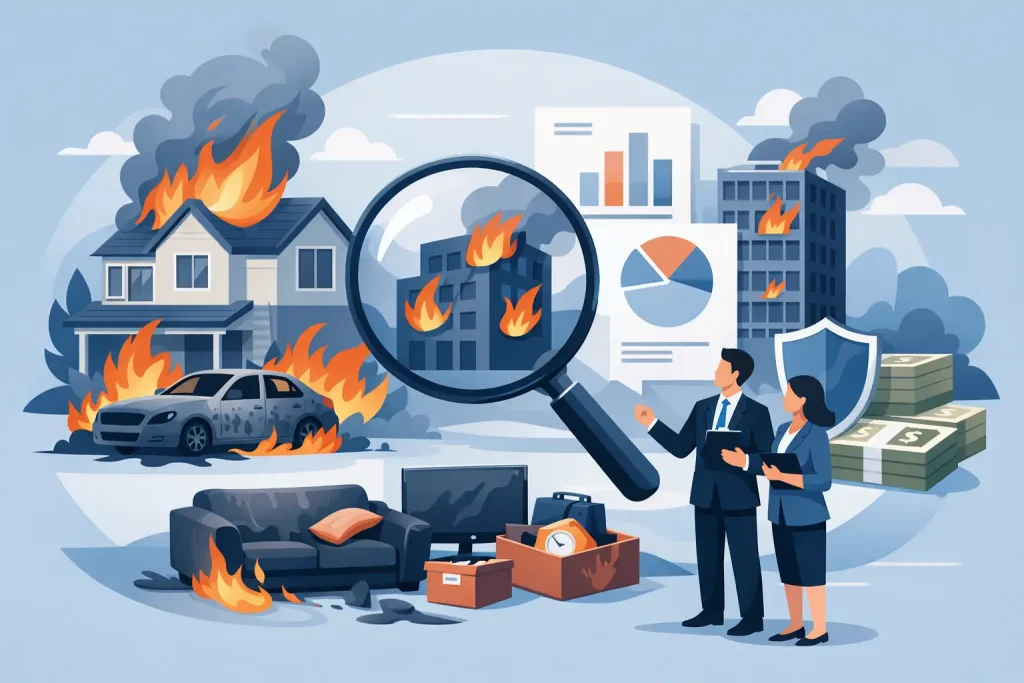
A major fire claim rarely begins with a neat file, a clear answer and a kettle on the desk. It begins with a phone call at an unhelpful hour, a building that may still be smoking, and an owner trying to grasp what has just happened to their livelihood. The most telling examples of major fire claims show that the flames are only the beginning. Afterwards come questions of cause, policy cover, business interruption, salvage, security and, occasionally, whether the story being told can possibly be true.
For a loss adjuster, the job is part investigator, part accountant, part practical problem-solver and, on the tougher days, part diplomat. A serious fire can turn a profitable business into a blackened shell overnight. Yet the quality of the response in the first few days often determines whether the business gets back on its feet or joins the long list of firms that never reopen.
The examples below are illustrative composites, drawn from the kinds of circumstances that repeatedly arise in major-loss work. Details vary, but the awkward truths do not.
Examples of major fire claims in the real world
The factory fire that stopped far more than production
A fire starts in a manufacturing unit during the night. By morning, the main production line has been badly damaged, stock is soaked, and smoke has reached offices, machinery and finished goods that were nowhere near the original seat of the fire.
The obvious claim is for the building, plant and stock. The larger problem may be the interruption to the business. Can orders be moved to another site? Is there spare capacity with a competitor or supplier? How long will replacement machinery take to source, install and commission? A shiny new machine is not much use if it requires six months of testing before it can make a saleable product.
This is where major claims cease to be merely about replacing burnt items. The policy may respond to loss of gross profit, increased cost of working and specialist expenses needed to keep trading. But calculations must be rooted in evidence: past accounts, order books, seasonal patterns and the reality of the market after the incident. A business that was already losing customers before the fire cannot fairly attribute every later shortfall to smoke and flames.
There is a human point, too. Directors usually want certainty immediately. The adjuster cannot honestly provide it immediately. Early decisions still matter: protect the site, preserve damaged evidence, identify stock, prevent water damage spreading and find a temporary route back into trading. A calm explanation is more useful than a theatrical promise.
The warehouse with a suspiciously convenient loss
Warehouses produce claims of impressive scale because they hold vast quantities of stock, much of it packed in cardboard, wrapped in plastic and difficult to count at the best of times. After a severe fire, the stock records become crucial. So do purchase invoices, sales records, delivery notes, bank statements and the physical remains.
One recurring difficulty is that insured values can bear little resemblance to reality. Some businesses underinsure without appreciating it, having left a sum insured unchanged while prices, stock levels and rebuilding costs have risen. Others may overstate what was there on the night, particularly where stock control was less a system than a hopeful glance around the shelves.
A claim should not be treated as fraudulent merely because it is large, badly presented or inconvenient. Equally, a sympathetic story is not evidence. Major-loss handling requires patience: compare the claimed stock to buying patterns, turnover, storage capacity and records created before anybody anticipated an insurance payment. Fire destroys material, but it often leaves behind enough clues to test a claim properly.
There is a trade-off. Insurers must investigate potential fraud, but unnecessary delay can compound a genuine policyholder’s loss. Security staff, emergency stock counts and agreed interim payments may be sensible while the more contentious issues are examined. Nobody benefits from treating every customer as a villain. Nobody benefits from treating every inconsistency as a typo either.
The hotel fire where the building was not the whole story
A hotel kitchen fire can be contained quickly yet cause a disproportionate loss. Heat, smoke and firefighting water do not respect departmental boundaries. Bedrooms may be untouched by flame but unusable because of odour, damaged services or evacuation requirements. Weddings are cancelled, conference bookings vanish and staff face an uncertain future.
The reinstatement question can be particularly thorny in older buildings. The owner may expect a like-for-like rebuild, while current building regulations demand upgrades to fire protection, accessibility or energy performance. Depending on the policy wording, some additional costs may be covered and others may not. It is one of those areas where reading the policy after the event is less satisfying than reading it before.
The business interruption claim also demands care. Hotels are seasonal. A fire before Christmas, during a major local event or in the height of the holiday period cannot be valued by simply dividing last year’s takings by twelve. At the same time, a projected surge in bookings must be more than optimism wearing a spreadsheet. The best claims are built from reservation data, cancellations, market evidence and a realistic recovery plan.
The tenanted commercial property with several competing interests
Consider a fire in a mixed-use commercial building: shops below, flats above, tenants with their own insurance, a landlord, a managing agent and a lender. The fire brigade has done its job, but the administrative parade is only assembling.
Who is responsible for the damaged roof? Who pays for alternative accommodation? Was the shop tenant required to maintain the electrical installation? Has the landlord complied with policy conditions? Is there an uninsured loss created by excesses, inadequate sums insured or exclusions? Each party may have a perfectly understandable view, and those views do not always travel in the same direction.
The practical priority is often making the premises safe and watertight, then establishing a clear programme for repairs. Delay invites further deterioration, theft and nuisance to neighbours. It can also turn a claim into a dispute simply because nobody knew who had authority to instruct works.
This is where experienced claims handling has an unglamorous virtue: good notes, clear instructions and an agreed scope of works. There is no memoir-worthy romance in recording a site meeting properly, but it can prevent a great deal of expensive shouting later.
What a major fire claim really tests
The cause of a fire matters, but it is rarely the only issue. Fire investigators may examine electrical equipment, heating systems, smoking materials, deliberate ignition, work processes and the spread of the blaze. Their findings can affect policy liability, recovery prospects against a third party and the safety lessons taken from the event. They should not be rushed into a conclusion simply because somebody wants a culprit by Friday.
Policy conditions matter too. Insurers may require reasonable precautions, maintained alarms, security measures or compliance with specific warranties. The wording, the facts and the law all matter. Sweeping statements such as “the claim is automatically void” are usually best avoided until someone has read the actual policy and established what happened.
Then there is reinstatement. Rebuilding after a major fire is a project, not a shopping trip. Costs can rise because of demolition, asbestos, planning, listed-building requirements, specialist equipment and a shortage of competent contractors. An early estimate is exactly that – an estimate. The sensible aim is not a falsely precise number on day two, but a controlled process that gives the insured, insurer and contractors a reliable route forward.
The habits that make the difference after a fire
Businesses cannot remove every fire risk, but they can avoid making a bad day immeasurably worse. Accurate asset and stock records, regularly reviewed sums insured, tested fire protection and a workable continuity plan are worth far more than their rather dull reputation suggests.
After the incident, preserve evidence before clearing it away, notify the insurer promptly, keep records of emergency spending and avoid authorising major reinstatement works without agreement. Emergency mitigation is often necessary, of course. A roof does not become less leaky while paperwork is completed. The point is to document what was done, why it was needed and what it cost.
For readers who enjoy the less polished side of the profession, The Perils of a Loss Adjuster offers the sort of perspective that rarely appears in a policy schedule: the peculiar characters, false starts and hard-won judgement behind claims work.
A major fire claim is never just a calculation. It is a test of records, judgement, patience and basic human decency under pressure. Get those things right early, and even a blackened building can become the start of a credible recovery rather than the end of the story.