
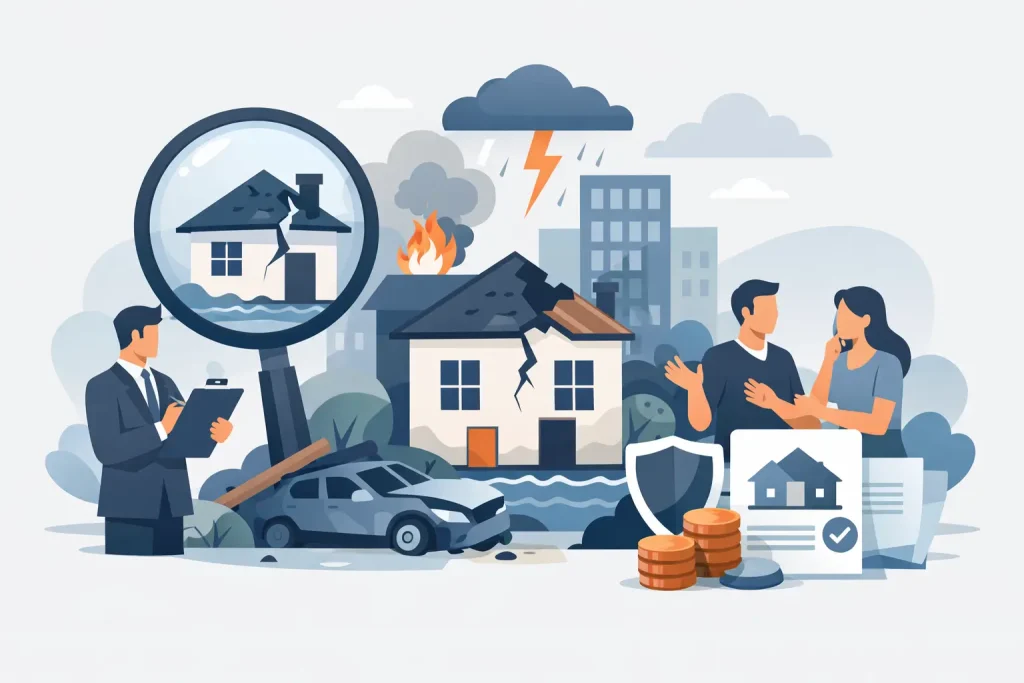
A burst pipe at half past six on a winter morning has a way of turning ordinary people into reluctant experts. One minute you are looking for the kettle, the next you are staring at a ceiling that has developed all the charm of a damp sponge. That is usually when understanding property damage claims stops being a theoretical nicety and becomes very personal indeed.
The trouble is that most people only meet the claims process when something has already gone badly wrong. They are stressed, short on sleep, and often convinced the insurer is sharpening a pencil somewhere in preparation for a grand refusal. Sometimes that suspicion is unfair. Sometimes, if we are being honest, it is not entirely baseless. Claims are not just about damage. They are about facts, timing, wording, evidence and, now and then, human behaviour at its least sensible.
What understanding property damage claims really involves
A property damage claim is not simply a request for money because something has been broken, soaked, burned or stolen. It is a formal examination of what happened, what the policy covers, what the damage actually amounts to, and whether any part of the loss falls outside the contract.
That may sound rather dry, but in practice it is full of judgement calls. A cracked wall might be the result of subsidence, impact damage, poor maintenance or an old issue that nobody fancied dealing with until now. A kitchen fire might be accidental, careless or, in rare and awkward cases, not accidental at all. The claim sits at the crossroads between event, evidence and policy wording.
For policyholders, the biggest misunderstanding is often the belief that if damage is real, payment is inevitable. Real damage is only the starting point. Insurers and loss adjusters are looking at cause, extent, timing, mitigation and ownership. If that sounds a touch forensic, it is because it is.
The first questions asked after damage occurs
When a claim lands on a desk, several questions appear almost immediately. What happened? When did it happen? Was the property insured at the time? Is the cause insured? Has the policyholder done what they reasonably could to prevent further loss?
Those questions are not designed to trap honest people, though they can feel that way. They are there because small details matter enormously. Escape of water, for example, may be covered, but long-term seepage caused by neglect may not be. Storm damage may be covered, but a fence that was already on its last legs can become a surprisingly philosophical object. Was it blown down by exceptional weather, or did the first enthusiastic gust simply finish off a structure that had given up months earlier?
That is where evidence becomes central. Photographs taken at the scene, invoices, repair estimates, proof of ownership and a clear timeline all help. The people who fare best are not always the most eloquent. They are usually the most organised.
Why timing matters more than people think
Delay has a habit of making a manageable claim look suspicious or confused. If a leak starts on Monday and the insurer hears about it three weeks later, questions follow naturally. Not because delay proves wrongdoing, but because it blurs the facts. Water staining spreads, damaged items are moved, and memories become oddly selective.
Prompt notification also helps with mitigation. That is the unglamorous insurance word for taking sensible steps to reduce further damage. Turning off the water, arranging emergency drying, boarding up a broken window or moving unaffected contents to safety are all part of the picture. Insurers generally expect common sense, not heroics.
Understanding property damage claims from the insurer’s side
It is fashionable to imagine insurers as eager to avoid paying claims at all costs. The truth is less theatrical and more bureaucratic. Most insurers want valid claims settled efficiently. Their difficulty is that valid claims arrive mixed in with exaggerated ones, poorly evidenced ones and the occasional work of pure fiction.
That is why adjusters ask what may feel like irritatingly detailed questions. They are trying to establish the mechanism of loss and the proper measure of indemnity. In plain English, what caused the damage and what does it fairly cost to put matters right, subject to the policy.
Indemnity itself causes endless confusion. Insurance is not usually meant to leave you better off than before the loss. That sounds obvious until someone with a ten-year-old carpet is unhappy to learn that a brand-new replacement may involve deductions, matching issues or limits on what is considered reasonable. Claims can be frustrating precisely because fairness and expectation are not always the same thing.
The awkward territory of wear and tear
If there is a villain in many property claims, it is not fraud. It is wear and tear. Policyholders tend to see the dramatic end result – the ceiling collapse, the rotten floor, the failed flat roof. Insurers look one stage earlier and ask whether gradual deterioration created the conditions for the damage.
This is where disappointment often takes hold. Insurance is designed for fortuity, not housekeeping. Sudden escape of water may be insured. A pipe that has been quietly leaking into a void for months while timbers rot away is a different matter. The line is not always clean, and disputes often live in that grey area.
The role of the loss adjuster
Loss adjusters are frequently introduced into this story as though they are part detective, part schoolmaster and part undertaker. That is occasionally unfair, though not always wildly inaccurate. Their job is to investigate, quantify and report. They do not write the policy, and they do not usually make the final underwriting decisions, but they are often the visible face of the process.
A decent adjuster will not merely search for reasons to decline. They will also identify what is covered, separate insured from uninsured damage, and help move a claim towards resolution. They have seen enough odd incidents to know that truth can look improbable. Real life is not tidy. People really do reverse into their own garage doors, leave baths running, and discover that a squirrel can create electrical havoc with more enthusiasm than a qualified contractor.
That said, adjusters also develop a reliable nose for embellishment. Claims become difficult when accounts change, documents arrive suspiciously late, or the list of damaged items expands in a manner that suggests a department store stocktake.
Common mistakes policyholders make
Most claim problems do not begin with dishonesty. They begin with assumption. People assume they know what their policy covers. They assume a verbal description is enough. They assume the insurer will infer the missing details kindly.
Another common error is throwing damaged items away too quickly. That is understandable if the sofa smells of smoke or the freezer contents have become a public health issue, but whenever possible, evidence should be kept or at least thoroughly photographed. Once an item is gone, arguments about age, condition and ownership become much harder to settle.
Then there is the estimate issue. One builder says the repair is £3,000, another says £9,000, and both sound confident enough to run the Treasury. Insurers will compare scope, rates, causation and necessity. The cheapest figure does not always win, but neither does the most theatrical.
Why some claims become disputes
Disputes usually arise from one of three places. The first is causation – what actually caused the damage. The second is scope – what damage is related to the insured event and what was already there. The third is value – what it reasonably costs to repair or replace.
Communication can make all three worse. Technical language, half-explained decisions and vague letters are petrol on a smouldering fire. Policyholders want plain answers. If part of a claim is excluded because of wear and tear, the reasoning needs to be explained properly. If matching materials are no longer available, someone needs to address whether a localised repair is fair or whether broader replacement is justified.
This is one reason people with industry experience tend to view claims with a mixture of sympathy and caution. On one side is a policyholder dealing with a damaged home or business. On the other is a contractual process trying to remain objective while facts are still emerging. Neither side is always as unreasonable as the other believes.
A more realistic way to approach a claim
The best approach is calm, prompt and evidence-led. Report the claim early. Be accurate rather than dramatic. Keep records of conversations, photographs, invoices and temporary repairs. Read the policy wording, especially any excesses, exclusions and conditions. If something is unclear, ask directly rather than guessing.
It also helps to accept that some outcomes are matters of judgement. Two competent professionals can differ on extent, drying times, repair methods or depreciation. That does not automatically mean one of them is bent. It may simply mean property claims are not machine-made decisions.
For anyone fascinated by what goes on behind the scenes, this is exactly why the subject has more life in it than outsiders imagine. A property damage claim is never just a wet carpet or broken roof tile. It is a story about contracts, people, pressure and the curious things that happen when everyday life collides with misfortune. Richard Thurstan’s world has long thrived on that tension, because insurance is rarely only about damage. It is about what damage reveals.
If you remember one thing, let it be this: the strongest claim is not always the loudest one, but the clearest one.