
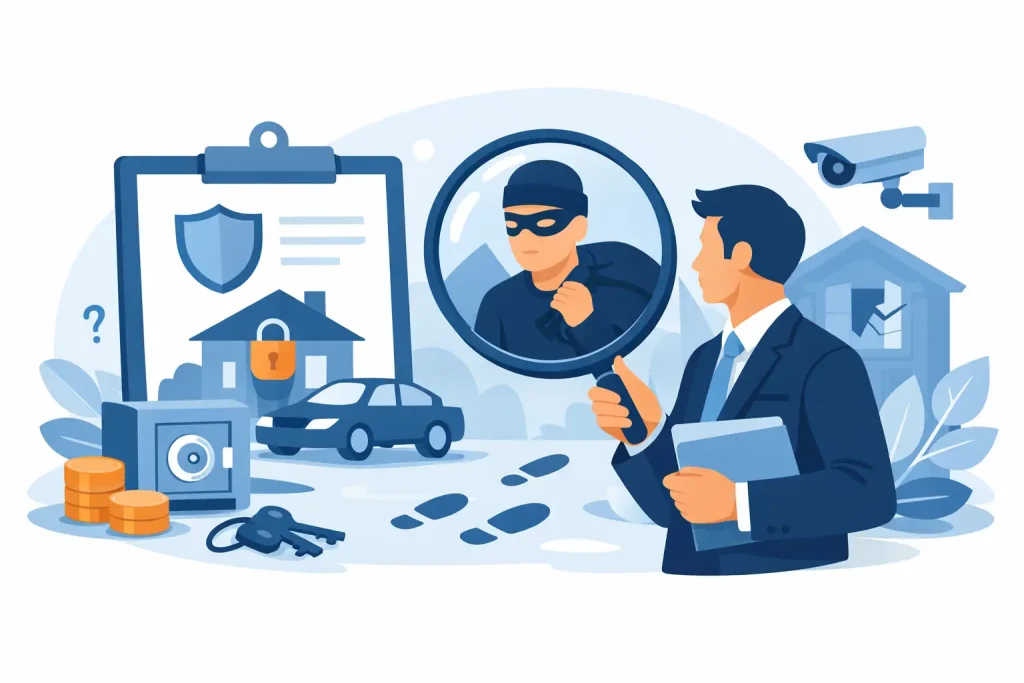
A theft claim often begins with a nasty surprise: a forced back door, an empty driveway, or the sudden realisation that the watch is no longer where it always was. Then comes a less welcome surprise for some policyholders – questions. Why do insurers investigate theft when the claimant has already had a miserable enough day?
The short answer is that an insurer must establish what happened, what was lost, and whether the policy responds. That is not a polite way of calling every claimant a fraudster. It is the ordinary work of claims handling, and a careful investigation can be as much in the honest claimant’s interests as the insurer’s.
Theft is an allegation, not yet a proven loss
Insurance is built on evidence, probability and the wording of a contract. A theft may be perfectly genuine, but the claim file still needs to show enough detail for an insurer to make a fair decision. What was taken? When was it last seen? How did the thief gain access? Was the item owned by the policyholder, and was it insured under this particular policy?
These are not academic questions. A bicycle stolen from an unlocked shed, for example, may raise a different issue from one taken after a padlock was cut. A mobile phone lifted from a table in a café may be covered, limited, or excluded depending on the policy’s unattended-property terms. The facts matter because the cover matters.
Loss adjusters are often asked to turn a confusing account into a clear chronology. That may mean speaking to the policyholder, reviewing photographs, checking a crime reference number, considering receipts or bank statements, and looking at the scene. It is less glamorous than television detective work, although the occasional soggy garage, aggrieved neighbour or implausibly selective burglar can provide its own entertainment.
Why do insurers investigate theft claims so carefully?
There are three connected reasons: confirming the loss, applying the policy fairly, and preventing dishonest claims from being paid from the collective premium pot.
First, insurers need a reasonable picture of the stolen property and its value. People do not always keep receipts for jewellery bought years ago, inherited possessions, tools accumulated job by job, or a much-loved guitar acquired before smartphones photographed every meal and every purchase. Lack of a receipt does not automatically mean lack of cover. But alternative evidence may be needed: old photographs, valuation documents, repair records, packaging, serial numbers, card statements or witness evidence.
Secondly, the insurer must test the circumstances against the policy terms. Home policies can contain single-item limits, requirements to specify high-value articles, conditions about alarms or locks, and restrictions on items left in vehicles or outbuildings. Commercial policies may involve stock records, security procedures and the distinction between employee dishonesty and an external break-in. An investigation is how these details are established rather than guessed.
Thirdly, theft claims attract fraud. That is not cynicism. It is a fact of insurance life. Some claims involve invented items, exaggerated values, staged burglaries or property said to be stolen after it has been sold, pawned or simply misplaced. Fraud costs money, and honest customers ultimately meet that cost through higher premiums. A proper enquiry protects the policyholder who has suffered a real loss from being lumped in with someone trying their luck.
A crime reference number is helpful, not a magic key
Reporting a theft to the police is usually sensible and often required by the policy. The crime reference number gives the insurer a starting point and helps demonstrate that the loss was reported promptly. It does not, however, oblige an insurer to pay the claim without further questions.
The police investigate whether a crime has been committed and, where possible, who committed it. The insurer investigates whether there is an insured loss under the policy. Those enquiries overlap, but they are not identical. Police resources are necessarily prioritised, and many theft reports will not result in forensic examination or an identified suspect. The claim still needs to be assessed.
Nor does the absence of a prosecution mean a claim is false. Insurance claims are usually decided on the available evidence and the balance of probabilities, not the criminal standard of proof. A decent insurer should keep that distinction firmly in view. It would be absurd to demand a conviction before paying every stolen-bike or burgled-home claim.
What an investigation may involve
The scale of the investigation should reflect the scale and complexity of the loss. A straightforward claim for a modestly priced item may be handled through documents and a telephone conversation. A substantial jewellery claim, a suspicious burglary, or a business stock loss may justify a visit from a loss adjuster, specialist investigator or forensic accountant.
The questions can feel personal because theft itself is personal. An adjuster may ask about household routines, who had keys, when the alarm was set, where an item was stored, financial pressures, recent purchases, and whether there have been previous claims. Asked clumsily, that can sound like an interrogation in a draughty police station. Asked properly, it is a method of checking a claim against the known facts.
Digital evidence has widened the picture. Location data, online sales listings, photographs with date information, security-camera footage, mobile phone records and bank transactions can sometimes support a genuine claim quickly. They can also reveal contradictions. This does not mean an insurer has unlimited rights to rummage through a claimant’s private life. Requests should be relevant, proportionate and explained. A fishing expedition is not good claims practice; it is merely expensive bad manners.
Honest claimants can make the process easier
The best time to prepare for a possible theft claim is before anyone has a reason to make one. Keep a simple home inventory for valuable belongings, photograph serial numbers where practical, retain valuations for jewellery and artwork, and check that items above the policy’s individual limit are declared. For businesses, stock records and asset registers are not dull administrative chores when £20,000 of equipment has vanished overnight. They are the difference between a quick discussion and a long reconstruction.
After a theft, report it promptly, preserve any evidence of forced entry, and make a written list while events are fresh. Be accurate rather than ambitious. If you are unsure of a model number or purchase date, say so. A claimant who distinguishes what they know from what they believe will usually be more credible than one who supplies a remarkably precise account that later proves rather elastic.
It also helps to answer requests directly and keep copies of what has been sent. Delays happen for many reasons: waiting for a valuation, checking a policy schedule, obtaining a police report, or clarifying ownership. But a file cannot move if key information remains in someone’s inbox. Equally, if a request seems excessive or irrelevant, ask why it is needed. Cooperation does not require blind acceptance of every demand.
Investigation is not the same as suspicion
This is the point most easily lost once a claim is underway. A request for proof of ownership is not necessarily an accusation. Nor is a visit from a loss adjuster. It may simply mean that the claim has reached the stage where someone needs to see the damaged lock, understand the layout of the premises, or reconcile the schedule with the list of missing property.
That said, insurers and their representatives have responsibilities too. They should communicate clearly, avoid needless delay, explain what information is relevant, and reach decisions based on evidence rather than hunches. A claimant who has been burgled should not be made to feel guilty for wanting the protection they paid for.
After more than a few years around claims, one lesson is hard to avoid: the facts are often messier than either side expects. People misremember dates. Receipts disappear. A thief may leave a window open and take only the most portable valuables. An investigation is there to separate understandable uncertainty from a material problem with the claim.
For readers who enjoy the stranger side of this work, The Perils of a Loss Adjuster offers a first-hand look at the people, predicaments and occasional absurdities that sit behind the paperwork. But the practical message is simple enough: a fair theft investigation is not a hurdle placed in front of a genuine claimant. Done well, it is the route by which a genuine claim is recognised, valued and paid.