
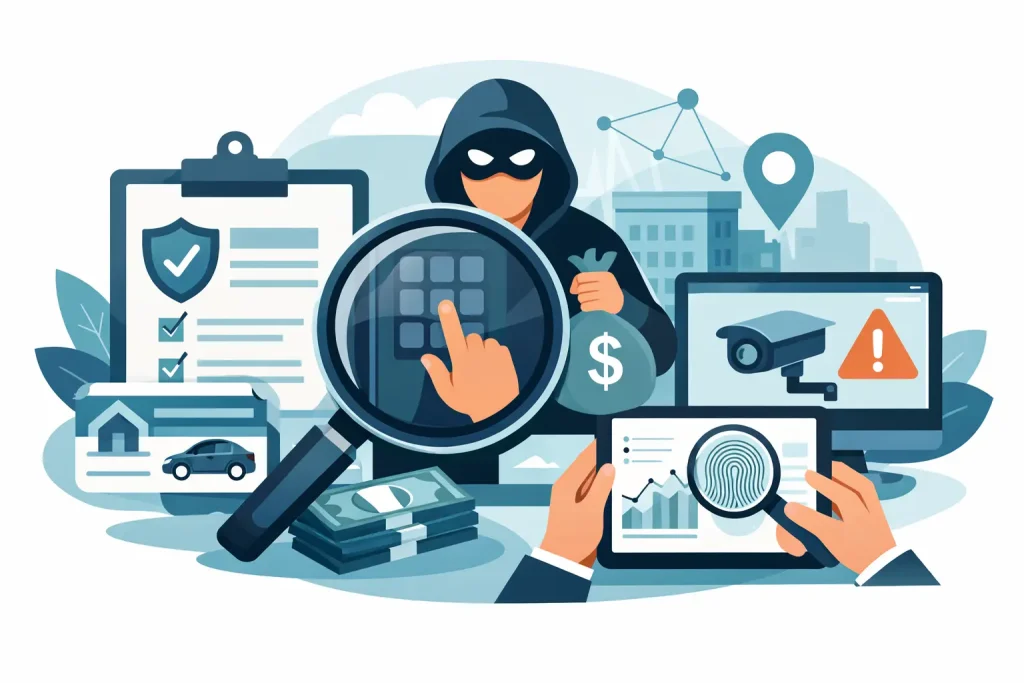
A claim rarely arrives wearing a sign saying fraudulent. It usually turns up looking perfectly ordinary – a burst pipe, a rear-end shunt, a stolen watch, a fire in a lock-up, a slipped tile, a bad back. The real question is how insurance fraud gets detected when, on the surface, it can look much the same as an honest loss. The answer is less dramatic than television suggests and rather more methodical. Most fraud is uncovered not by genius theatrics, but by experience, pattern recognition and a refusal to stop asking sensible questions.
Anyone who has handled claims for years develops a nose for what does not sit quite right. That instinct is useful, but instinct alone does not get a claim over the line. Suspicion has to be tested. A good loss adjuster, claims handler or investigator is not paid to be cynical about everyone. They are paid to separate the genuine claimant having a miserable week from the storyteller who has started too confidently and hopes no one will notice the joins.
How insurance fraud gets detected in practice
The first thing worth saying is that fraud detection often starts with inconsistency, not proof. A claimant says the jewellery was kept in a bedside drawer, then later says it was locked in a safe. The timing of a burglary changes by an hour. A vehicle is allegedly stolen from one street, but a petrol receipt places the driver somewhere else. None of these points, on their own, proves dishonesty. Honest people misremember, especially after a distressing event. But when the details shift in the wrong places and always in the claimant’s favour, eyebrows rise.
The second trigger is context. Claims do not exist in a vacuum. They are read alongside the policy wording, the claimant’s history, the condition of the property, prior losses, financial circumstances and the practical realities of everyday life. If a warehouse fire occurs two weeks after stock levels were said to be poor and creditors were circling, someone will want a closer look. If a supposedly accidental damage claim appears just after a policy is upgraded, that timing matters too. Timing is not guilt, but timing is never irrelevant.
Then there is the detail of the damage itself. Physical evidence can be wonderfully unromantic. It does not care for dramatic explanations. A door that was allegedly forced may show damage inconsistent with an external break-in. A water stain may reveal a long-term leak dressed up as a sudden escape of water. Fire patterns, tool marks, weather conditions and repair histories all tell their own story. Often, the building is a better witness than the policyholder.
The human side of spotting suspicious claims
A surprising amount of detection comes from conversation. People inventing an account often over-explain the unimportant bits and skate over the practical ones. They can sound rehearsed in one moment and vague in the next. Ask a straightforward follow-up question – where exactly was the item purchased, who last saw it, why was it stored there, what happened next – and the narrative may wobble.
That said, seasoned handlers know not to mistake nerves for guilt. Plenty of honest claimants sound flustered because they are upset, embarrassed or simply not used to being questioned. The trick is not to play amateur psychologist. It is to compare what is said with what can be verified. Experience teaches you that confidence can be faked far more easily than facts.
Documentation helps here, though even paperwork has to be handled with care. Receipts, bank statements, photographs, repair invoices and proof of ownership can support a claim beautifully. They can also raise fresh doubts if dates do not align, fonts look suspiciously modern for an old receipt, or a document appears oddly convenient. Fraudsters have become more sophisticated, but so have insurers. A document is not accepted because it exists. It is accepted because it makes sense in the wider picture.
Data, patterns and the quieter tools
Much of modern fraud detection is less cloak-and-dagger and more data-led housekeeping. Claims are screened for patterns that merit further review. Repeated losses, unusual frequency, links between parties, addresses that crop up too often and claims that resemble known fraud types can all trigger a second look. This does not mean a machine declares someone a villain. It means the claim is flagged for human judgement.
That balance matters. Data is excellent at spotting repetition and anomaly. It is less good at understanding the entirely plausible oddity of real life. A person may have several legitimate claims because they are unlucky, live in a flood-prone area or run a chaotic household with three teenagers and a trampoline. A human being still has to decide whether the pattern is suspicious or merely unfortunate.
Insurers also compare statements against external information where lawfully available and relevant. Social media is an obvious example, though it is often overhyped. The dramatic tale of a supposedly injured claimant posting holiday photos on a jet ski does happen, but most detection is more mundane. It might be a location inconsistency, a timeline mismatch or evidence that an item was owned for less time than claimed. Again, one post rarely decides a case. It contributes to the overall picture.
Why site visits still matter
Desk-based checks are useful, but a visit can change everything. Seeing a property, meeting a claimant and examining the scene often reveals what files cannot. You notice whether a forced entry looks theatrical, whether damaged items fit the account given, and whether the household described in the claim resembles the one in front of you.
There is also something to be said for ordinary observation. A claimant insisting they owned a house full of designer goods may live in a way that makes that less than convincing. That sounds harsh, and it should be handled carefully, because people prioritise spending differently. But the experienced eye notices when the alleged lifestyle and the physical environment are miles apart.
In commercial claims, site visits can be even more revealing. Stock levels, business records, security arrangements and staff recollections often expose the difference between a genuine disaster and a suspiciously convenient one. Businesses under strain do not always turn fraudulent, but financial pressure has a habit of encouraging creative narratives.
When experts get involved
Some claims need specialist input. Engineers, forensic accountants, fire investigators, medical experts and handwriting analysts may all play a part, depending on the allegation. Their value is not just technical. They help strip away speculation. If an engineer says the damage developed over months, the claim of a sudden incident starts to collapse. If an accountant finds inflated turnover figures or impossible stock valuations, the commercial loss begins to look less unfortunate and more imaginative.
The trade-off is cost and proportion. Not every suspicious claim deserves a full orchestra of experts. Insurers have to weigh the likely value of the claim, the seriousness of the concerns and the evidence already available. There is no sense spending a fortune proving what common sense and modest enquiries could establish. Equally, there is every reason to investigate properly where the facts warrant it.
False positives and the danger of cynicism
One of the less glamorous truths is that insurers must be careful not to see fraud everywhere. Overzealous suspicion can damage trust, delay valid settlements and make an already stressful event worse for honest customers. The best professionals know this. They do not start from the assumption that everyone is at it. They start from the evidence and let that lead where it leads.
That is why the strongest fraud detection is disciplined rather than dramatic. It relies on chronology, corroboration and context. Does the account stay consistent? Does the damage match the story? Do the documents stack up? Is the timing plausible? Can independent evidence support the version of events? One awkward answer means very little. Ten awkward answers usually mean rather more.
For readers who enjoy the world behind the paperwork, this is where insurance becomes unexpectedly human. Fraud detection is not merely about catching rogues. It is about judgement, scepticism in healthy doses, and understanding how people behave when money, stress and opportunity all meet in the same room. Some claims unravel because of technology, some because of science, and a good many because someone with long experience quietly thinks, not quite.
If there is a helpful lesson in all this, it is that honest claims tend to survive scrutiny remarkably well. They may be messy, imperfect and supported by less paperwork than anyone would like, but the truth usually has a way of lining up. Fiction, by contrast, needs constant maintenance – and that is often how it gives itself away.