
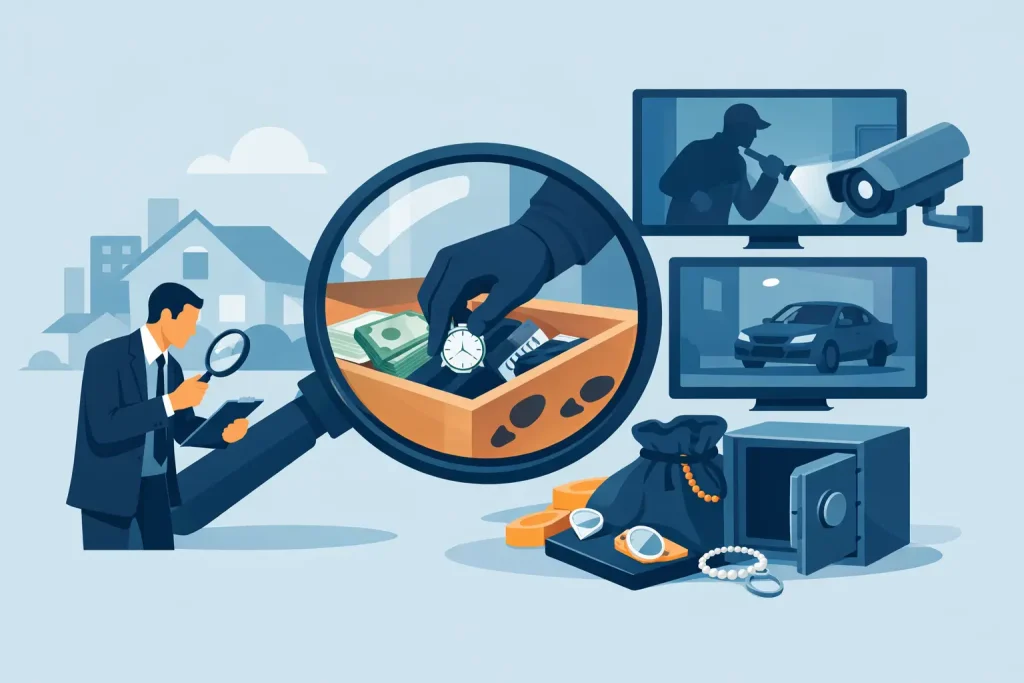
A theft claim often begins with a sentence no one enjoys hearing: “It was there last night.” From that point, the file can head in several directions at once – genuine loss, muddled recollection, poor record-keeping, or, every so often, a story that wilts under daylight. How theft claims are investigated is not nearly as theatrical as television would have you believe, but it is far more methodical, and usually far more revealing.
For anyone outside the trade, there is a persistent assumption that insurers either pay too quickly or wriggle too hard. The reality is less dramatic and more procedural. A theft claim sits at the awkward junction of distress, inconvenience and suspicion. Most policyholders are honest. Some are mistaken. A small minority are inventive. The investigator’s job is not to play detective for the fun of it, but to establish what happened, whether the policy responds, and whether the loss presented is the loss actually suffered.
How theft claims are investigated in practice
The first stage is deceptively simple. The insurer or loss adjuster gathers the basic facts: what was taken, when it was last seen, when the theft was discovered, where the property was kept, and how entry or access was gained. That sounds straightforward until people are asked to be precise. Dates blur. Values become optimistic. A watch purchased ten years ago somehow remembers its original box, valuation and sentimental worth all at once.
That is not automatically suspicious. It is human nature. A theft leaves people feeling exposed, and memory does not improve under stress. Good investigators know this. They will allow for the ordinary untidiness of life while still testing the account. The key question is consistency. Does the story hold together over time, under detail, and against the available evidence?
A routine theft claim will usually begin with a claim form, a statement, and a crime reference number. From there, the paper trail matters enormously. Purchase receipts, bank or card statements, photographs, serial numbers, repair invoices and valuation documents can all help show that an item existed, belonged to the claimant, and had a plausible value. The lack of paperwork is not fatal in itself, particularly for older possessions, but it does shift the emphasis onto credibility and surrounding evidence.
The evidence behind a theft claim
There is usually less glamour here than people imagine. Most investigations turn on ordinary documents and ordinary questions. Was there forcible entry? Were the locks damaged? Was the vehicle actually secured? Were there signs of rummaging, selective taking, or a rather curious absence of disruption where a burglar had allegedly been busy? A scene often tells its own quiet story.
In household thefts, investigators will look at access points, alarm records, key control and occupancy. If a house was supposedly entered while the owners were away, neighbours may have seen something, or perhaps seen nothing at all. If expensive items vanished but easier portable property remained untouched, that can prompt further thought. Professional thieves can be selective, certainly, but so can people drafting an ambitious schedule of loss from the comfort of the kitchen table.
Commercial theft claims add another layer. Stock records, till figures, delivery notes, wastage reports and security procedures come under scrutiny. If a shop reports a large stock loss, the investigator will want to know whether there was proper stock reconciliation before the incident, whether shrinkage had been creeping up for months, and whether the theft is masking a bookkeeping problem. It is remarkable how often theft is invited to explain what poor controls have already caused.
Vehicle theft claims are equally revealing. Modern cars leave a digital trail, and so do their owners. Investigators may check both sets of keys, service history, finance records, CCTV, telematics and mobile phone data where relevant and proportionate. If a car was said to be parked in one place but other evidence places it elsewhere, the claim quickly becomes less comfortable. If only one key exists where two were issued, that will not be ignored.
Why insurers ask awkward questions
People are often offended when asked about finances, prior claims, occupancy, relationships in the household, or recent policy changes. Yet these questions are not asked for sport. Motive matters in fraud enquiries, and context matters even in honest claims. A policy taken out or significantly increased shortly before a loss may be entirely innocent, but it is still a fact worth understanding. A household under financial strain may have a genuine theft – or may present a temptation someone eventually accepted.
Previous claims history is another point of tension. One prior theft means very little on its own. Several similar losses, all with thin evidence and curiously high valuations, begin to form a pattern. Insurers do not investigate patterns because they enjoy being cynical. They investigate because repetition has a habit of meaning something.
There is also the simple issue of policy cover. Many theft claims fail not because the loss did not happen, but because the policyholder did not do what the policy required. A bike left unsecured in a communal hallway, jewellery left in an unattended car, stock stored outside security conditions, keys left in the ignition – these are not charming details. They go to the heart of whether cover applies.
How theft claims are investigated when fraud is suspected
Most files never reach this stage. But when something jars, the pace changes. The claim may be referred to a specialist fraud team or a more experienced adjuster. Statements are reviewed in detail. Timelines are rebuilt. Documents are checked more closely, and third-party enquiries may become more extensive.
This is where the little things matter. A receipt with the wrong font, a valuation that predates the supposed purchase, an online marketplace image passed off as a personal photograph, or a witness account that politely contradicts the policyholder – none of these on their own always settles the matter, but together they can dismantle a claim with depressing efficiency.
Interviews become more focused too. A skilled interviewer is not looking for melodrama. He or she is looking for clarity, sequence and reaction to detail. Honest people can be mistaken, flustered or annoyed. Fraudsters can be smooth. There is no single mannerism that proves anything. What matters is whether the explanation survives contact with specifics.
Sometimes the issue is exaggeration rather than fabrication. A genuine burglary occurs, but the loss expands as the schedule develops. One stolen laptop becomes two. A modest television ages into a top-end model. Clothing values take on a grandeur not visible in the wardrobe itself. This is still fraud if done knowingly, even if the original theft was real. That catches some claimants by surprise.
The balance between scepticism and fairness
The best adjusters are not the ones who assume everyone is at it. They are the ones who know how to separate weakness from dishonesty. Plenty of entirely valid claims arrive with patchy paperwork, vague dates and poor descriptions. Real life is untidy. People do not keep a museum archive of every toaster, bracelet or power tool they have ever owned.
Equally, some deeply dubious claims arrive wrapped in immaculate presentation. Files can look impressive and still be false. That is why experience matters. One learns to notice what fits naturally and what has been assembled a little too carefully.
There is also a practical reason for taking time. A rushed decline can be as bad as a rushed payment. Reject a genuine claim unfairly and you do damage not only to the customer but to trust in the process. Pay a dishonest one and the cost turns up for everyone else sooner or later. That tension sits behind almost every theft investigation.
What policyholders can do to help
If there is one unfashionable truth, it is that preparation before any loss makes life much easier after one. Keep receipts where you can. Photograph valuable items. Record serial numbers. Make sure valuations are current for higher-value pieces. Understand the security conditions in the policy rather than discovering them after the back door has been found ajar.
And when making a claim, resist the temptation to guess. If you do not know, say so. If a value is approximate, say that too. Nothing unsettles a claim faster than confidence that later has to be revised. Investigators are used to uncertainty. They are much less fond of certainty that melts.
There is a reason theft claims have filled so many war stories in the insurance trade, and not all of them printable over lunch. They sit in that curious space where human misfortune, poor memory, carelessness and opportunism all rub shoulders. For readers who enjoy seeing how these situations really unfold behind the office door, that is exactly the sort of territory Richard Thurstan has spent a career navigating.
A theft claim is rarely just about a missing item. It is about evidence, behaviour, timing and whether the account stands up when the dust settles. And if that sounds less like paperwork and more like human nature in a suit, that is because it usually is.