
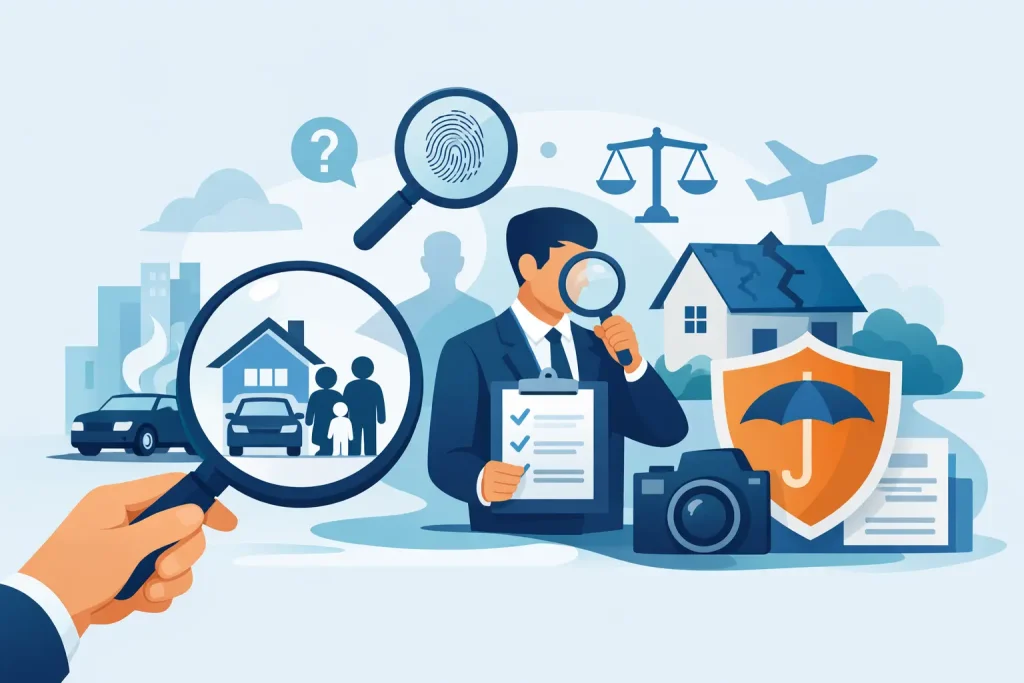
A householder reports a burst pipe, a shop owner swears the stock vanished overnight, and a driver insists the accident happened exactly as described. On paper, a claim can look perfectly straightforward until one awkward detail refuses to sit still. That is usually where questions begin, and it is exactly how insurance investigations work in the real world – less trench coat and magnifying glass, more patient fact-checking with a healthy respect for human nature.
For anyone outside the trade, the phrase can sound rather dramatic. It conjures up hidden cameras, whispered phone calls and some poor claimant being treated like a criminal for daring to submit a loss. The truth is both more ordinary and more interesting. Most investigations are simply the process of testing whether a claim is covered, accurately presented and supported by evidence. Sometimes that confirms everything quickly. Sometimes it reveals misunderstanding, exaggeration or, on occasion, outright fraud.
Why insurance investigations happen at all
Insurers do not investigate claims for the sport of it. They investigate because they have a duty to pay valid claims properly and a duty not to pay invalid ones. Those two obligations sit side by side, and anyone handling claims for long enough learns that getting the balance right matters.
If an insurer pays every claim without question, premiums rise for everybody and fraudsters have a field day. If it treats every claimant as a villain, it delays genuine settlements and creates a misery machine. The art lies in knowing when a claim is routine and when it needs a closer look.
That closer look can be prompted by all sorts of things. The facts may not match the policy wording. The timeline may feel odd. Documents may be missing. The value claimed may be surprisingly high. A previous claims history may suggest a pattern that deserves attention. None of that proves dishonesty. It merely means the file has started asking questions of its own.
How insurance investigations work in practice
In practice, an investigation usually begins quietly. A claims handler notices an inconsistency, asks for further information or refers the matter to a loss adjuster, fraud team or specialist investigator. Contrary to popular myth, this is rarely a theatrical moment. It is often just a note on a file that says, in effect, this needs checking.
The first stage is usually documentary. Policy schedules, proposal forms, photographs, receipts, repair estimates, bank statements, proof of ownership, engineering reports, CCTV, telephone records and weather data can all come into play depending on the claim. In property losses, the investigator may want to know not just what was damaged, but when, how, by whom and whether the policy was in force on the relevant date. In liability claims, they may examine contracts, maintenance records and witness accounts. In motor matters, vehicle telematics and accident reconstruction might join the party.
After that comes conversation. Statements are taken, clarifications requested and timelines revisited. This is one of the more revealing parts of the process, not because people always lie, but because memory is a slippery thing. A perfectly honest claimant can be hazy on dates, values or sequence. Equally, a dishonest one may offer detail where none is needed, then stumble over simple facts.
Site visits are common where the physical scene matters. If a warehouse roof supposedly collapsed in a storm, someone may inspect the structure. If jewellery was allegedly stolen in a burglary, the property layout, entry points and security arrangements may be examined. A good investigator is not merely looking for evidence that supports suspicion. They are looking for evidence full stop, even if it clears the claimant entirely.
Who actually carries out the investigation?
That depends on the type and size of the claim. A straightforward issue may be handled by the insurer’s own claims team. More complex or higher-value cases often involve loss adjusters, who assess the facts on the ground and report back. Specialist fraud investigators may be brought in when there are strong indicators of deliberate deception. Solicitors, forensic accountants, engineers, surveyors and digital analysts can all appear when the circumstances demand it.
This is where outsiders are sometimes surprised. Insurance investigations are not usually run by one all-knowing figure in a crumpled mac. They are pieced together by a cast of professionals, each looking at a different corner of the same puzzle. The engineer may explain why the fire spread as it did. The accountant may test whether the business interruption figures stack up. The adjuster may compare all of it against the policy and the story given.
What investigators are really looking for
At heart, most investigations revolve around a handful of questions. Did the event happen as described? Is the loss covered under the policy? Is the amount claimed fair? Has the claimant given a true and complete account? That sounds simple enough until real life gets involved.
Take accidental damage. One person’s mishap is another person’s wear and tear in fancy dress. A cracked floor tile may be a sudden insured event, or it may be gradual deterioration that has finally become impossible to ignore. A stolen item may genuinely have disappeared, or it may never have existed in the condition or quantity claimed. In commercial losses, stock records can be wonderfully persuasive until one discovers they were updated with optimism rather than accuracy.
Then there is motive, which must be handled carefully. Financial pressure, recent policy changes, previous losses or overdue debts may justify extra scrutiny, but they are not proof of wrongdoing. Plenty of honest people are unlucky, disorganised or under strain. Insurance people ignore that at their peril.
Suspicion is not the same as fraud
This is the point most worth making. Being investigated does not mean a claimant has been branded a fraudster. It means the insurer needs enough information to make a sound decision. Sometimes a claim looks suspicious only because the early paperwork is incomplete or badly explained. Once the full picture appears, the matter settles perfectly properly.
Other times, the investigation uncovers exaggeration rather than invention. That distinction matters. A claimant may have suffered a real loss but rounded the figures up with more enthusiasm than accuracy. That can still have serious consequences, but it is not the same thing as fabricating an event from thin air.
And yes, there are cases where fraud is clear. Invented thefts, staged accidents, inflated invoices, manipulated documents and deliberate arson are not the fantasies of cynical adjusters. They exist. Anyone who has spent years in claims will have encountered enough improbable stories to know that truth is often stranger than fiction and usually less tidy.
Why genuine claimants sometimes find the process frustrating
Because it is frustrating. A person may have just suffered a fire, flood, theft or serious accident and then be asked for bank records, purchase receipts and a detailed chronology of events. From their point of view, it can feel intrusive or accusatory. From the insurer’s point of view, it may be entirely necessary.
This is where experience counts. The best investigators know that a valid claimant deserves respect, speed and plain English. They also know that rushing to judgement helps no one. There is a world of difference between asking careful questions and behaving as though one is conducting an interrogation at Scotland Yard.
It also explains why communication matters so much. Delays without explanation breed resentment. Sensible requests, clearly framed, tend to get better cooperation. Most people can accept being asked for evidence. What they dislike is feeling ignored, patronised or left in the dark.
The human factor that no file can fully capture
If there is one lesson claims work teaches repeatedly, it is that paperwork tells only part of the story. People misremember. They panic. They guess. They omit facts they think are irrelevant, only to discover those facts were the hinge on which the whole claim turned. Others present themselves badly while being entirely genuine. A few present themselves beautifully while being as crooked as a dog’s hind leg.
That is why good investigations rely on judgement as much as procedure. The process needs structure, certainly, but it also needs seasoned scepticism without becoming sour. Anyone can be cynical. The real skill is staying curious.
For readers who enjoy the strange machinery behind ordinary mishaps, this is one of the most revealing corners of insurance. It shows an industry trying to separate error from deceit, misfortune from opportunism, and fact from the polished version produced after a difficult weekend. Richard Thurstan’s The Perils of a Loss Adjuster lives in precisely that territory, where serious work and human absurdity are seldom very far apart.
The next time you hear that a claim is under investigation, do not assume villainy or bureaucracy for its own sake. More often, you are seeing a system trying, with varying degrees of grace, to decide what really happened. And in insurance, as in life, that is rarely the simplest part.
2 responses