
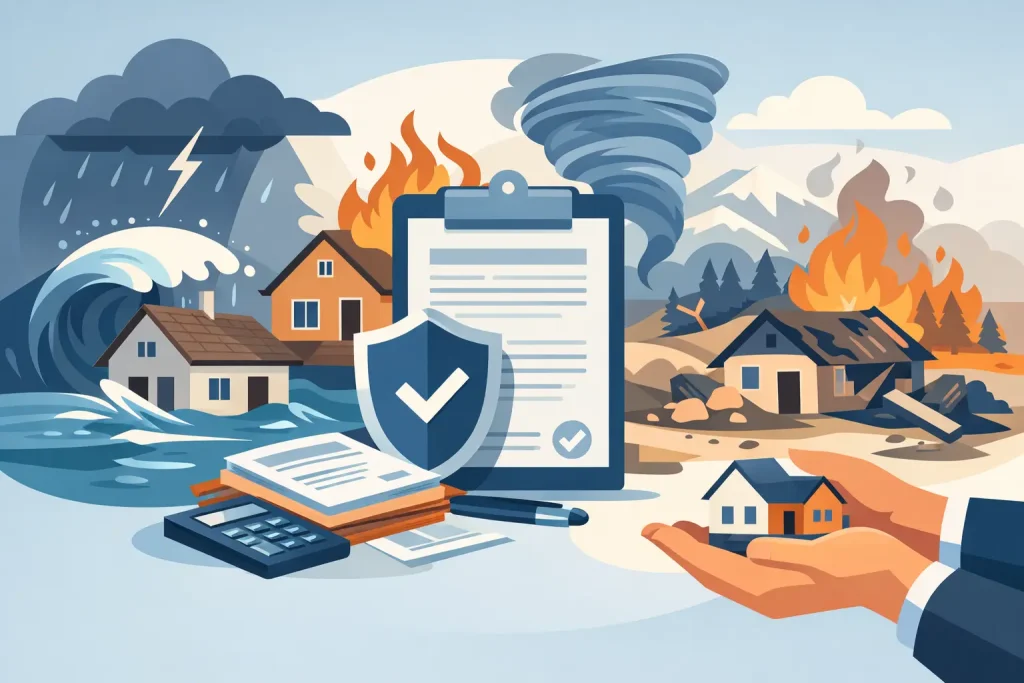
A catastrophe claim rarely begins with paperwork. It begins with a telephone ringing far too early, a policyholder speaking too quickly, and somebody on the other end trying to describe the sort of damage that makes ordinary language feel inadequate. That is why catastrophe insurance claim stories are so often memorable. They are not simply about buildings, stock, or policy wordings. They are about shock, confusion, split-second decisions, and the awkward business of restoring order when life has plainly gone off script.
People outside the trade sometimes imagine catastrophe work as a larger version of a normal claim. More damage, more cost, more people involved. In one sense that is true. In another, it misses the point entirely. A burst pipe in a semi-detached house may be upsetting, but a flood through a village, a warehouse fire that puts dozens out of work, or a storm that strips roofs across a town changes the atmosphere of every conversation. The claim becomes part logistics exercise, part detective work, part grief management.
Why catastrophe insurance claim stories linger
The best catastrophe insurance claim stories stay with people because they expose character very quickly. Disaster has a habit of stripping away polish. Some claimants become practical and clear-headed within minutes. Others are understandably stunned. A few discover a previously hidden talent for creative accounting.
For the adjuster, broker or insurer, these cases are never just about the schedule and the sum insured. They are about triage. What must happen today, what can wait until Friday, and what absolutely cannot be taken at face value? Catastrophe work punishes hesitation, but it also punishes overconfidence. Visit too soon and you may be working through confusion and rumour. Wait too long and the site, the evidence, and the claimant’s faith in the process may all deteriorate together.
That tension is what gives these stories their shape. Every experienced claims professional can remember a file where the obvious answer turned out to be wrong, or where a perfectly ordinary-looking loss concealed a much larger problem underneath.
The first hours are rarely tidy
When people tell catastrophe stories in retrospect, they often tidy them up. The call came in, the expert attended, the damage was measured, and everyone behaved sensibly. Real life is not usually so obliging.
Take a serious commercial fire. By the time the adjuster arrives, the fire brigade may still be damping down, the owner may be insisting that the entire business is ruined, a director may be talking about suspicious circumstances, and three different employees may have three different versions of what was in the building. The broker wants reassurance, the insurer wants facts, and the insured wants money yesterday.
None of that means anyone is being difficult. It simply means catastrophe creates noise. Facts emerge in layers. One of the most valuable skills in loss adjusting is the ability to remain calm while everyone else is narrating the end of the world.
That calm is not coldness. Quite the reverse. People remember the professional who speaks plainly, does not bluff, and explains what happens next without drowning them in jargon. In major losses, certainty is often impossible, but steadiness is not.
Floods create a different sort of story
Flood claims are their own breed of misery. Fire is dramatic and immediate. Flooding can feel personal in a different way. Mud in the kitchen, ruined family photographs, soaked stock, contaminated plant – the damage has a grubby persistence to it. It gets into corners, under floors, behind walls and, rather unhelpfully, into people’s tempers.
Some of the most revealing catastrophe insurance claim stories come from flood events because they force everyone to confront delay. Drying takes time. Stripping out takes time. Decisions about repair versus replacement take time. For homeowners, that can feel unbearable. For businesses, it can become existential.
This is where experience matters. A less seasoned handler may focus entirely on visible damage and miss the interruption loss building quietly in the background. A better one knows that the soaked carpet is only part of the problem. The real issue may be the lost trading weeks, the displaced staff, the spoiled records, or the customer confidence that drains away while the premises sit unusable.
Flood claims also remind us that policyholders are not all equally prepared. Some keep exemplary records. Some can barely find the policy number. A catastrophe is an unforgiving moment to discover the filing system was based on optimism.
Human nature enters the room very quickly
No memoir of claims work would be worth reading if it pretended catastrophe was only a technical process. It is, in truth, a parade of human behaviour under pressure.
There is generosity. Neighbours house one another. Competitors lend equipment. Staff turn up to salvage stock from a blackened site because they cannot bear to abandon the business. These moments rarely make headlines, but they are common enough to deserve mention.
There is also opportunism. A genuine catastrophe has a way of attracting inflated inventories, convenient memories, and the occasional item that was apparently priceless only after it vanished in smoke or water. Fraud in major losses is seldom as theatrical as fiction suggests. More often it is incremental. A little exaggeration here, a little selective recollection there. Enough, if left unchecked, to turn a valid claim into something else entirely.
This is one of the awkward truths that catastrophe stories tell particularly well. Sympathy and scepticism have to sit side by side. An insured may be suffering a perfectly genuine loss and still overstate part of it. Good claims handling has room for compassion without becoming gullible.
The paperwork matters, but not in the way outsiders think
People often assume insurance work is dominated by forms, clauses and dreary correspondence. There is certainly no shortage of paperwork, and any professional who claims to love every schedule, estimate and proof of loss should probably be watched. But in catastrophe claims, documents matter because they help reconstruct reality.
What stock was actually there? What machinery was in use? What turnover was expected this quarter? Which repairs are emergency mitigation and which are improvements that somebody fancies having funded by the policy? These are not abstract questions. They shape outcomes.
Yet paperwork has its limits. A catastrophe scene can tell its own story to an experienced eye. The burn patterns, the line of flood debris, the condition of locks, the position of salvaged goods, the timing of notifications – all of it can support or undermine the account being given. Sometimes the file confirms the site visit. Sometimes the site visit quietly demolishes the file.
That is partly why stories from this world are so compelling. They show a profession that is far more observational than many people realise. A good adjuster is not merely reading documents. He is reading people, places and inconsistencies.
What these stories teach the rest of us
For insurance professionals, catastrophe stories are practical education in a more memorable form. They show how quickly small oversights become expensive ones. Underinsurance that looked manageable on a spreadsheet can become brutal after a major event. Poor business continuity planning, vague stock records, unresolved maintenance issues, and leisurely claims notification all have a habit of coming back at the worst possible moment.
For general readers, the appeal is slightly different. These stories open a door onto a profession usually encountered only after something has gone badly wrong. They reveal the odd mixture of judgement, patience and stubbornness needed to separate fair claims from fantasy, urgency from panic, and genuine hardship from tactical performance.
That is one reason books such as The Perils of a Loss Adjuster resonate beyond the trade. The subject may look technical from a distance, but the stories are recognisably human. Catastrophe sharpens everything – fear, resilience, honesty, self-interest, gratitude and occasionally absurdity.
Not every catastrophe claim has a neat ending
This may be the least glamorous truth of the lot. Some losses are settled efficiently and well. Others drag. Contractors disagree, accountants argue over business interruption, coverage points emerge late, and exhausted policyholders begin to suspect that every answer generates two further questions.
That does not always mean the process is broken. Sometimes a large claim is simply large, and complexity is unavoidable. But it does explain why catastrophe stories are so often told with a mixture of pride and exasperation. The work can be deeply satisfying, but it is rarely clean.
And perhaps that is the real value in these stories. They remind us that insurance is not at its most interesting when everything behaves as expected. It becomes interesting when weather, fire, impact, collapse or plain bad luck test the promises on the page. At that point, character matters as much as coverage, and experience counts for far more than theory.
The next time you hear one of those apparently outlandish claim tales, do not dismiss it as trade folklore. In catastrophe work, the extraordinary is often just Tuesday – and there is usually a useful lesson hiding behind the smoke, mud or broken masonry.