
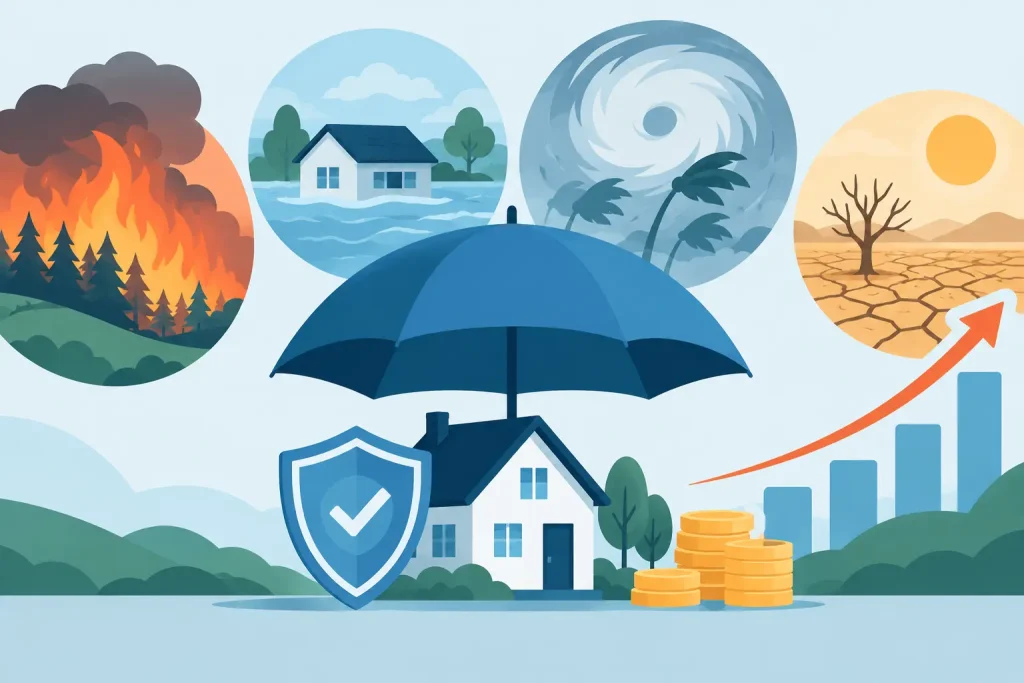
The telephone does not ring more urgently because a storm has acquired a name. Yet, after a night of exceptional rain or a week of stubborn heat, the calls arrive in clusters: water through ceilings, shops shut by floodwater, cracked roads, damaged stock and bewildered policyholders asking the perfectly fair question, “Am I covered?” Rising climate insurance losses are not an abstract concern for an annual report. They are the costly, messy reality that lands on kitchen floors, factory yards and loss adjusters’ desks.
For those of us who have spent years dealing with claims, the change is not simply that weather events are getting more expensive. It is that losses are becoming harder to separate, harder to price and harder to repair. A flooded home may once have been an isolated misfortune. Now it can be one of several hundred claims in the same postcode, all competing for drying equipment, builders and surveyors.
Why Rising Climate Insurance Losses Matter
Insurance works best when bad luck is spread widely. Many people pay a premium so that the relatively few who suffer a genuine loss can be put back, as far as money can manage it, to where they were before. Severe weather puts pressure on that arrangement when one event affects thousands of people at once.
The immediate bill is only part of it. A storm may damage roofs, overwhelm drains, close roads and interrupt businesses across a region. The resulting claim can include alternative accommodation, lost trading, professional fees, debris removal and the higher cost of scarce labour and materials. A modest escape of water can be dealt with by a plumber and a dehumidifier. A widespread flood is a different beast altogether.
There is also a temptation to treat every wet summer or hot spell as proof of a simple story. Claims professionals should resist that. Not every flood is caused solely by climate change, and not every damaged property was properly maintained. A blocked culvert, a neglected roof or development on a floodplain can turn difficult weather into a much larger loss. The point is not to argue over a single raindrop. It is to recognise that more volatile weather is exposing weaknesses in buildings, infrastructure and insurance assumptions.
The Claim Starts Long Before the Adjuster Arrives
When catastrophe strikes, the visible damage draws the eye. The less visible preparation often decides whether a claim proceeds smoothly or becomes an unhappy saga involving damp plasterboard, missing invoices and several increasingly fraught telephone calls.
For householders, the practical basics remain wonderfully unfashionable: know where the stopcock is, keep gutters and drains clear, photograph valuable possessions, and read the policy before the river is halfway up the drive. For a business, the equivalent means maintaining premises, protecting stock, backing up records and having a credible continuity plan. None of this guarantees cover or prevents a storm. It does, however, make the difference between a manageable interruption and an expensive scramble.
The policy wording matters too. Flood, storm, subsidence, escape of water and gradual deterioration are not interchangeable labels. Insurers investigate the cause because the cause can determine whether the policy responds, what excess applies and which repairs are reasonable. That can feel pedantic to a policyholder standing in a soaked sitting room. It is nevertheless the work. Insurance is a contract, not a charitable collection tin, though a sensible handler never needs to explain that fact without a little humanity.
Evidence is dull until it is invaluable
The best time to gather evidence is immediately after it is safe to do so. Photographs and video of the damage, receipts for emergency purchases, a record of conversations and proof of ownership can all prevent delay. Businesses should record lost turnover and extra costs separately rather than attempting to reconstruct them from memory six months later, when every recollection has become rather more heroic.
That said, policyholders should not wait for permission to take sensible emergency action. Stopping further damage, arranging urgent drainage or securing a broken window is usually common sense. Keep the receipts, notify the insurer promptly and avoid authorising a full rebuild before the scope has been agreed. There is a sensible middle ground between doing nothing and hiring a restoration crew with the enthusiasm of a royal visit.
Premiums Are a Symptom, Not the Whole Story
When losses rise, premiums usually follow. That is neither a moral judgement on homeowners nor evidence that insurers have developed an expensive taste for villainy. Premiums reflect claims experience, projected risk, repair costs, reinsurance and the amount of capital insurers must hold to pay major losses. If all those ingredients become dearer, cheap cover becomes harder to sustain.
The awkward truth is that the impact will not be evenly shared. Two similar homes may face very different prices because one lies near a watercourse, has a history of surface-water flooding or sits in an area where insurers have limited appetite for new business. For some properties, cover may be available but subject to a larger excess or more restrictive terms. For others, the market may be thin enough that shopping around produces very little cheer.
That is why the debate cannot end with “insurers should pay more”. Insurers need to pay valid claims promptly and fairly, certainly. But communities also need better drainage, thoughtful planning, resilient building standards and maintenance of public infrastructure. Asking an insurance policy to solve every failure of planning and prevention is rather like using an umbrella to mend the roof.
What Good Claims Handling Looks Like Under Pressure
A surge event tests an insurer’s character. Policyholders do not particularly care how clever the catastrophe model was if nobody answers the telephone and the contractor cannot attend for three weeks. Good handling begins with clear communication: what is known, what is covered in principle, what immediate steps to take, and when the customer can expect an update.
It also requires triage. Vulnerable customers, unsafe properties and businesses facing imminent closure must be identified quickly. Remote assessment technology can help establish priorities, particularly where roads are impassable, but it is not a substitute for experienced judgement. A photograph can show a wet wall. It cannot always show the smell, the extent of contamination, the condition of the structure or the look on a policyholder’s face when they realise they cannot sleep in their own bed.
The adjuster’s role is not to arrive with a clipboard and a repertoire of reasons to say no. It is to establish the facts, interpret the policy, control the cost of the claim and help move matters towards a fair resolution. Those responsibilities can pull in different directions. Paying for work that is unnecessary is unfair to the wider pool of policyholders. Quibbling over a plainly valid claim is unfair to the person who bought the policy in good faith. The professional task is to hold both truths at once.
Adaptation Is Becoming Part of the Insurance Conversation
Repairing damage exactly as it was can be a false economy if the same loss is likely to recur. After flooding, that might mean raising electrical sockets, using more water-resistant materials, fitting flood doors or altering landscaping to direct water away from the building. After repeated heat or storm damage, it may involve roof improvements, shading, ventilation or stronger fixings.
There are trade-offs. Resilient reinstatement can cost more at the outset, and policy terms may not always pay for every improvement a property owner would like. Listed buildings, leasehold arrangements and planning restrictions can complicate matters further. Still, a serious discussion about resilience is preferable to a second claim that begins, with grim familiarity, in precisely the same place as the first.
For insurance professionals, this is where technical knowledge must meet plain English. Customers do not need a lecture on catastrophe modelling while their shop is closed. They need to understand what can be done now, what the policy will fund and how sensible repairs may reduce future disruption.
After more than forty years around claims, the stories that endure are rarely about policy clauses alone. They are about people under pressure: the business owner protecting a lifetime’s work, the family trying to rescue photographs, the contractor who finds a practical answer when everyone else sees a problem. That human side is one reason the trade is far less dry than outsiders imagine, as explored in The Perils of a Loss Adjuster.
The weather may become less predictable, but a good response need not be. Keep the property maintained, keep records worth having, understand the cover you buy and act quickly when trouble arrives. In a changing climate, preparation is not glamorous. It is simply cheaper than surprise.