
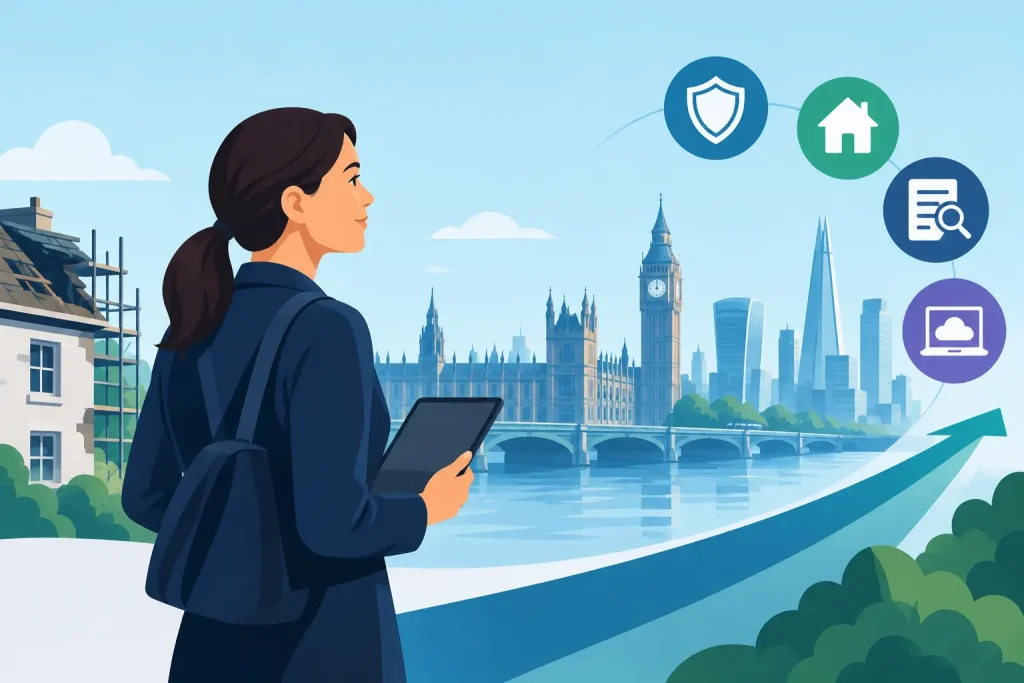
A burst pipe does not care about anyone’s digital transformation plan. Nor does a fire at a warehouse, a disputed theft claim or a flood that leaves a family staring at soaked carpets and an uninhabitable house. Someone still has to arrive, establish what happened, make sense of competing accounts and move a difficult situation towards a fair outcome. That is why the future of loss adjusting careers is rather more interesting than the usual prediction that a computer will simply take the job.
Loss adjusting has always sat where money, evidence and human behaviour meet. It can involve soot under the fingernails, a spreadsheet full of invoices, an awkward conversation with a policyholder, and a healthy suspicion of a claim that looks just a little too neat. Technology will alter the working day considerably. It will not remove the need for professional judgement. If anything, it will make that judgement more visible – and more valuable.
The future of loss adjusting careers is not a vanishing act
The routine end of claims work is already becoming faster. Photographs can be assessed by image-recognition tools; policy documents can be searched in moments; repair estimates can be compared against vast pools of previous data. Drones can inspect unsafe roofs and remote video calls can establish the basics of a straightforward escape-of-water claim before an adjuster has put the kettle on.
For insurers, this is sensible. A minor, well-documented claim should not require a procession of people, forms and appointments that costs more than the damage itself. Customers also expect speed, particularly when they are displaced from home or unable to trade. A policyholder whose shop is closed does not want a lecture on legacy processes.
But a claim is not merely a sequence of boxes waiting to be ticked. Facts are often incomplete. Damage has consequences beyond the visible breakage. A business interruption loss may depend on records that are patchy, a supplier overseas, a landlord who is slow to respond, and an owner who has never had to explain their turnover under pressure. The software can flag an anomaly. It cannot always tell whether the anomaly is fraud, muddle, panic or a perfectly innocent quirk of the business.
That distinction is the territory of the experienced adjuster. The profession will probably become smaller in its most repetitive corners, but stronger in complex property, liability, major loss, catastrophe, technical investigation and fraud-related work. Claims handling may become more automated. Loss adjusting will remain necessary when the story does not fit the template.
Less paperwork, more judgement
The great promise of claims technology is not that it replaces people, but that it removes some of the work that never needed much human brainpower in the first place. Few adjusters entered the profession because they were longing to re-key policy details or chase the same document for the fourth time.
Used well, automation can free time for site inspections, clearer reports, better reserve advice and more meaningful contact with customers and insurers. It can also give newer practitioners access to information that once took years to accumulate: comparable repair costs, weather records, construction data and patterns in suspicious claims.
There is a catch. If an organisation treats every claim as a data exercise, it risks losing the context that makes a good decision defensible. A photograph can show a cracked wall; it cannot reliably explain whether the crack is recent, whether it relates to the insured event, or whether the building had been quietly moving for a decade. A model can assign a probability. The adjuster has to explain the conclusion in language that an insurer, broker, solicitor and policyholder can understand.
That ability to write clearly will matter more, not less. In a profession filled with technical terms and contractual clauses, a concise, well-reasoned report is a practical skill. It prevents arguments, helps decisions travel through an insurer’s claims process, and shows the reader that the person reaching a conclusion has actually considered the evidence.
The human moment still matters
There is another part of the job that no portal handles particularly well: the first conversation after something has gone badly wrong. A household has lost possessions with sentimental value. A family business is worried about wages. A property owner believes a contractor has made matters worse. In such moments, people want competence, certainly, but they also want to feel that someone is listening.
Empathy is not softness or an invitation to abandon the policy wording. It is the ability to deal with people honestly while maintaining professional boundaries. The best adjusters have always understood this. They can ask difficult questions without turning the meeting into an interrogation, and they can deliver unwelcome news without sounding as though they are enjoying it.
New routes into the profession
Traditionally, loss adjusting has often been learned through exposure: a junior colleague follows a more experienced adjuster, reads files, visits losses and gradually discovers that every apparently simple claim has a surprise tucked behind it. That apprenticeship model remains useful, though it will need to adapt.
The next generation will need a broader mix of skills. Insurance knowledge and policy interpretation remain fundamental, as do investigation, negotiation and report writing. Alongside them will sit confidence with claims platforms, data literacy, digital evidence and remote inspection tools. A person does not need to be a programmer to thrive, but they should be comfortable asking sensible questions of the systems that influence their decisions.
Specialism will also offer attractive routes. Construction and engineering claims, cyber incidents, environmental damage, supply-chain interruption, agricultural losses and catastrophe response all need people who can learn the language of a sector quickly. The strongest career may not be built by trying to know everything. It may be built by becoming exceptionally reliable when a particular kind of loss becomes complicated.
For school leavers and career changers, the profession has an advantage that it does not advertise loudly enough: no two weeks are quite the same. One file may require accounting logic, another a building surveyor’s eye, another a tactful meeting with a distressed customer. It suits curious people who prefer real-world puzzles to abstract office theatre.
Catastrophe work will test capacity
Weather-related events are likely to put pressure on the market with uncomfortable regularity. Flooding, storms, subsidence and wild swings in temperature do not just create more claims. They create clusters of claims in the same places at the same time, when local contractors, accommodation and expert support are already in short supply.
In those periods, the value of an adjuster is measured partly by stamina and organisation, but also by calm. Insurers need accurate information quickly. Policyholders need practical answers. Everyone wants a repair plan, although the available trades may have other ideas. Technology can help triage and map affected properties, yet it cannot manufacture skilled tradespeople or settle an argument about causation on its own.
This is likely to make catastrophe experience a significant career asset. It is demanding work, often involving travel and long hours, so it will not suit everyone. But for those who can combine technical discipline with a cool head, it offers experience that cannot be gathered from a classroom or a dashboard.
The risk of losing the craft
There is a genuine concern beneath all the optimism. If simple claims are increasingly handled without adjusters, where will future senior practitioners gain their early experience? The routine files once taught people how policies work, how damage presents itself and how customers react. Remove every lower-complexity claim from human hands and the profession could create a shortage of people ready for the difficult ones.
Firms will need deliberate training, proper supervision and opportunities for juniors to review automated decisions rather than merely accept them. Experienced adjusters should pass on the habits that software cannot supply: take photographs that prove a point, ask the question nobody has asked, keep an open mind, and never confuse a confident claimant with a reliable account.
There is plenty of material in Richard Thurstan’s The Perils of a Loss Adjuster to remind readers why those habits matter. Behind every file reference is a situation involving people, property, money and occasionally behaviour so improbable that it would be rejected from a television script for lack of realism.
A career for people who can think on their feet
The profession will change, as it has changed before. Paper files gave way to digital systems; long drives and site meetings are now joined by video calls, drone footage and instant access to records. Yet the central question remains stubbornly familiar: what happened, what does the policy cover, and what is the fair, evidence-based way forward?
For anyone considering a career in loss adjusting, the sensible response to technology is neither fear nor blind enthusiasm. Learn the tools, understand the data, and do not surrender your judgement to either. The future belongs to adjusters who can bring order to a messy claim, explain their reasoning plainly and retain their humanity when somebody else’s bad day has just landed on their desk.