
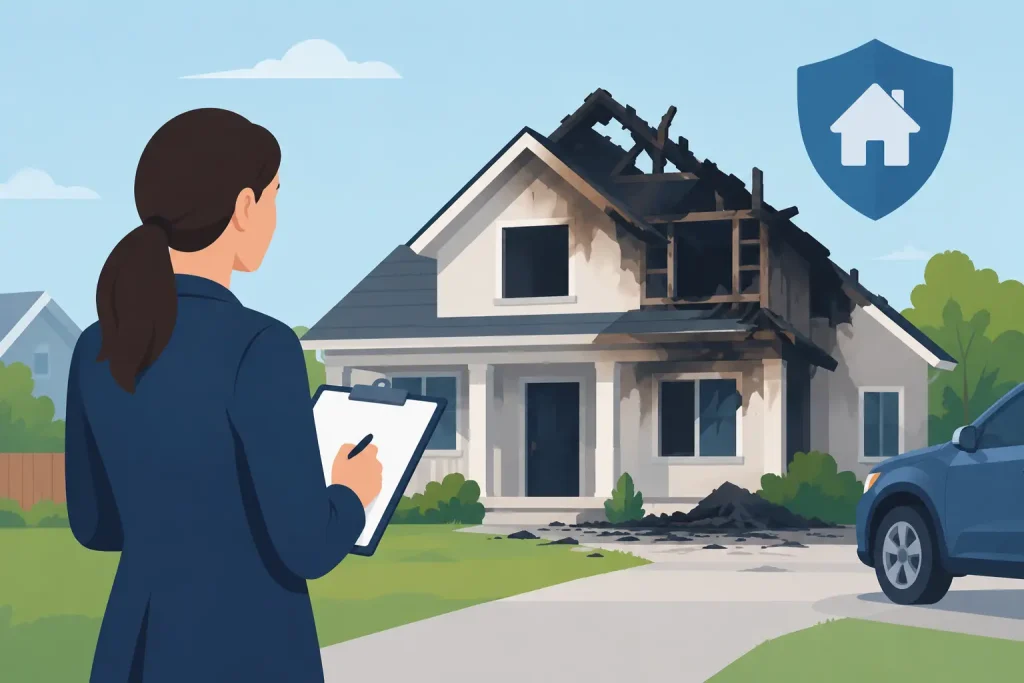
A fire claim is never merely about blackened walls, a damp carpet and a list of ruined possessions. An arson claim scenario arrives with a more awkward passenger: doubt. The policyholder may be shocked and exhausted, neighbours may have theories before the fire engines have left, and insurers must decide what happened without mistaking suspicion for proof.
That is where loss adjusting earns its keep. The job is not to play detective in a trench coat, nor to treat every fire as a crime. It is to establish the facts carefully enough that the right claim is paid, the wrong claim is challenged, and everyone is treated fairly while the evidence is still warm – figuratively, one hopes.
Why an arson claim scenario is different
Most household and commercial fires begin with ordinary, unhappy causes: faulty wiring, cooking left unattended, a discarded cigarette, machinery overheating, or a candle placed far too close to something that should not be anywhere near a flame. A fire can look dramatic without being deliberate. Conversely, a suspicious-looking incident may have an entirely innocent explanation once the building, policy and circumstances are properly examined.
The difficulty is that arson is not usually proved by one theatrical clue. A broken window, a recent financial problem or a claim for expensive contents may justify further questions, but none is a verdict. In practice, a loss adjuster is dealing with two overlapping issues. First, what caused the fire? Second, does the policy respond to the loss, given the insured’s involvement, the policy terms and the information provided?
Those questions must be kept separate. Fire investigators may assess origin and cause. Police may investigate potential criminality. The insurer considers coverage. A loss adjuster helps bring the evidence into sensible order, while recognising that a claim file is not a courtroom and a gut feeling is not an evidential standard.
The first hours: protect people, premises and evidence
The first concern is always safety. A burned property can remain dangerous long after the flames are out. There may be unstable ceilings, contaminated water, exposed electrics, asbestos-containing materials or weakened steelwork. Commercial premises can also present a less obvious risk: a business desperate to reopen before the building is safe or before the scene has been properly documented.
Early attendance matters because fires are untidy witnesses. Rain, emergency salvage work, unauthorised entry and well-meaning clearance can alter a scene quickly. The adjuster will normally arrange appropriate site security, emergency drying or protection where needed, and make sure no one starts disposing of potentially relevant material prematurely.
At this stage, the best work is calm rather than clever. Take photographs, establish who had access, preserve key documents and obtain the initial account while it is fresh. That account may later need testing, but it should not be extracted like a confession over a cup of stewed tea. People who have just seen their home or livelihood damaged by fire are often distressed, muddled and understandably impatient for answers.
Building the timeline, not a theory
A sound investigation starts with chronology. When was the property last occupied? Who discovered the fire? Who had keys, alarm codes or access to the yard? Was the alarm set? Were there previous electrical faults, contractor visits, threats, break-ins or recent disputes? At a business, had trading reduced, stock increased unusually, or equipment been moved shortly before the incident?
Each answer leads to documents and independent checks. Alarm records, CCTV, telephone data where lawfully available, invoices, bank records, stock sheets, maintenance logs and witness accounts may all have a place. The point is not to rummage through somebody’s life in the hope of finding something embarrassing. It is to test material facts that bear on cause, opportunity, value and policy coverage.
Financial pressure is a classic example of a fact that is relevant but not decisive. Plenty of people and businesses face cash-flow trouble without setting fire to anything. Equally, a thriving enterprise can present a fraudulent claim. The sensible question is not, ‘Does this look suspicious?’ It is, ‘What evidence supports or contradicts this explanation?’ That small change in language prevents a great deal of bad decision-making.
The value of independent expertise
Where deliberate ignition is a realistic possibility, specialist fire investigation is often essential. A suitably qualified investigator can examine fire patterns, appliances, electrical installations, fuel sources and the likely area of origin. Their work may narrow the possibilities, identify an accidental cause, or leave the cause undetermined.
‘Undetermined’ is not a failure. Fire can destroy the very evidence needed to explain it. It also does not automatically mean arson, nor does it automatically entitle an insurer to decline a claim. The insurer still needs to consider the available evidence as a whole and apply the policy fairly. The answer may be uncomfortable for those who prefer a neat ending, but insurance claims are not always neat.
Speaking to the policyholder without making matters worse
An arson allegation can be ruinous even when it is only implied. A policyholder may be temporarily homeless, unable to trade and worried that neighbours or staff are whispering. That demands care in both language and process.
The adjuster should explain what information is required and why, set realistic expectations about timescales, and avoid promising an outcome before the investigation is complete. Requests for documents should be proportionate and clear. If the insurer needs a more detailed interview, it should be conducted professionally, with the policyholder given a fair opportunity to explain apparent inconsistencies.
There is a practical reason for this as well as a moral one. People are more likely to cooperate when they understand the process. They are also more likely to provide useful context. A discrepancy in a stock schedule may turn out to be a bookkeeper’s error; a missing alarm record may reflect a system fault already reported to the installer. Treating every imperfection as deceit is a quick route to a poor file and an even poorer reputation.
That does not mean naivety. Accounts should be checked, changing explanations should be explored, and inflated claims should not be waved through because the fire itself was genuine. A valid fire loss can still contain exaggerated contents, invented stock or opportunistic additions. Claims handling requires an open mind, not an empty one.
Coverage, causation and the decision to pay
A fire policy will usually cover fire damage, subject to its wording, exclusions, conditions and the circumstances of the claim. If there is evidence that the insured deliberately caused or arranged the fire, cover may be excluded and the claim may be declined. If a third party caused it, the position can be very different. The insurer may pay the insured, subject to the policy, and later consider recovery from the responsible party.
The facts matter beyond the question of who lit a match. Underinsurance may affect settlement. Evidence of contents ownership and value may be required. Business interruption claims need careful work on turnover, saved costs, extra expenses and the period needed to resume trading. A warehouse fire, for example, can create a substantial interruption claim even where the building damage is relatively straightforward.
Speed matters, but so does sequence. It can be right to make interim payments or arrange emergency accommodation while other issues are investigated, depending on the evidence and policy position. It can also be right to pause settlement of disputed elements. The aim is neither to pay first and think later nor to let a genuine claimant drift into hardship while everyone waits for a perfect answer that may never arrive.
The human judgement behind the paperwork
Good loss adjusting is often invisible when it works well. The site is secured, the experts are instructed, the insured knows what is happening, and the evidence is gathered without unnecessary drama. That takes judgement, persistence and a tolerance for the fact that people are at their least organised when something catastrophic has occurred.
It also takes a sense of proportion. A suspicious fire demands rigorous scrutiny, but scrutiny should be directed by evidence rather than swagger. A loss adjuster who assumes innocence regardless of the facts is not doing the insurer any favours. One who assumes guilt because a claim is inconvenient is no better.
Stories from the claims world are full of flames, false starts and odd explanations, which is one reason the profession offers richer material than outsiders expect. Richard Thurstan’s The Perils of a Loss Adjuster draws on that territory: the serious business of putting facts in order, with the occasional reminder that real life rarely follows the script.
For a policyholder caught up in a fire investigation, the most useful approach is simple: preserve what you can, provide records honestly, ask what happens next, and do not fill gaps in your memory with guesses. For the claims professional, the corresponding discipline is just as simple, though rarely easy: follow the evidence, explain the process, and remember that behind every scorched doorway is a person waiting to know whether their life can begin to look normal again.