
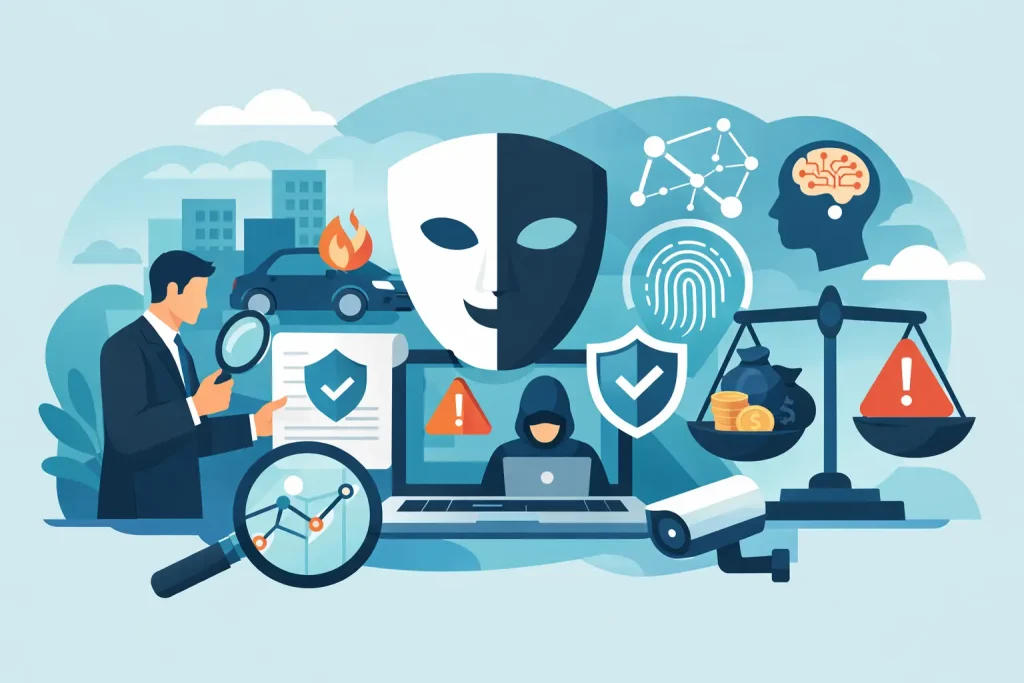
A suspicious claim rarely arrives wearing a striped jumper and carrying a bag marked “swag”. More often, it looks perfectly ordinary: a cracked windscreen, a stolen laptop, a burst pipe, a whiplash allegation or a business interruption loss with a very tidy spreadsheet. That is why trends in insurance fraud detection matter. The modern challenge is not simply finding the obvious rogue. It is spotting the small inconsistencies hidden among thousands of genuine claims, without treating every honest policyholder as though they have just made off with the Crown Jewels.
For those of us who have spent time in claims, the central truth remains reassuringly familiar: fraud is a human problem. Technology is changing the speed and scale of detection, but it has not removed the need for curiosity, sound judgement and the occasional well-timed awkward question.
Trends in insurance fraud detection are changing claims work
The most visible change is the move from investigating fraud after a payment has been made to identifying risk much earlier. Insurers increasingly use data at quotation, policy inception, first notification of loss and throughout the life of a claim. A mismatch in an address, a curious pattern of previous losses or a repair estimate that does not sit comfortably with the reported damage can be flagged before the file has gathered dust on three desks.
This does not mean every flagged case is fraudulent. Far from it. A flag is an invitation to look more closely, not a verdict. Someone may have several previous claims because they have had spectacularly bad luck, live in a theft-prone area or own a property that has been trying to return to the sea since 1974. Claims work becomes dangerous when suspicion is mistaken for proof.
The practical benefit of earlier triage is that straightforward claims can be settled promptly while unusual ones receive proper attention. That is better for customers and better for insurers. Nobody wants a genuine claimant left waiting because an investigator is buried beneath a mountain of perfectly normal escape-of-water claims.
AI is becoming a sorting tool, not a replacement adjuster
Artificial intelligence is now being used to compare claim details, identify patterns and assess documents, images and repair estimates. It can spot repeated bank details, similar wording across supposedly unrelated claims, improbable timings and networks of connected people or businesses. It is particularly useful where fraud is organised, repetitive and spread across multiple insurers.
Image analysis is another growing area. Systems can examine photographs for signs of manipulation, compare vehicle damage with the described accident, or highlight when the same photograph has appeared elsewhere. This is useful, although photographs have always had a habit of telling only the part of the story their owner wishes to tell. A close-up of a damp patch can look like the end of civilisation; a wider shot may reveal a leaking washing-machine hose and a rather damp sock.
Yet AI has limits. It relies on the quality of its data, and historical data can contain historical bias. If a system learns from poor past decisions, it may become efficiently wrong, which is not a quality any claims department should aspire to. Human oversight is essential, particularly where a decision affects a claimant’s reputation, cover or access to a fair settlement.
The old detective skills still earn their keep
For all the clever software, some of the strongest indicators of fraud remain stubbornly old-fashioned. Does the account make sense? Do dates, receipts, damage and witness evidence agree? Is the claimed item appropriate for the policyholder’s circumstances? Has a contractor produced an estimate with a suspiciously elastic relationship to reality?
A good loss adjuster does not begin by assuming dishonesty. They begin by establishing facts. That means listening carefully, checking documents, inspecting damage where necessary and allowing the evidence to lead. The difference may sound subtle, but it matters enormously. An aggressive investigator can turn an innocent discrepancy into an unnecessary dispute. A passive one can be taken for a costly ride.
Field investigation also remains valuable in complex property, liability and commercial claims. A visit to a premises can reveal details no spreadsheet can capture: the condition of stock, the layout of a building, whether alleged damage could have happened as described, or whether a supposedly closed business appears busier than a Saturday market. Desk-based handling is efficient, but it is not always enough.
Fraud is becoming more organised and more digital
Individual opportunism has not disappeared. There will always be someone tempted to add a television that was never owned, inflate a repair bill or turn an old dent into a recent calamity. But insurers are also focused on organised fraud, where groups exploit weak controls at scale.
In motor insurance, this can involve staged collisions, exaggerated injury claims, suspect credit-hire arrangements or linked repairers and claimants. In household insurance, it may involve repeat theft claims, fabricated invoices or the deliberate worsening of genuine damage. Commercial claims can present a different sort of difficulty, particularly where trading records, stock levels and interruption calculations leave plenty of room for creative interpretation.
Digital channels create opportunities for both sides. They make it easier for customers to report a claim, upload evidence and receive a decision quickly. They also make it easier to obtain convincing-looking fake invoices, altered photographs and persuasive documents. Generative AI has added a new wrinkle: a document can now look polished and plausible without ever having existed outside a laptop screen.
That does not mean insurers should greet every PDF with a frown and a magnifying glass. It does mean verification needs to be proportionate and intelligent. Checking a supplier, validating an invoice sequence, comparing evidence against independent records and asking for an explanation where something jars are sensible precautions, not theatrical displays of mistrust.
Data sharing brings benefits and responsibilities
One of the more significant trends in insurance fraud detection is the use of shared intelligence. Patterns that look harmless within one insurer’s book may become meaningful when viewed across the market. Linked addresses, repeated professionals, recurring accident circumstances or serial claims can be easier to identify when information is compared properly.
There is, however, a clear responsibility to handle personal data lawfully and fairly. Fraud prevention cannot become an excuse for indiscriminate surveillance or for labelling people on the basis of a postcode, occupation or an algorithmic hunch. Insurers must be able to explain their processes, protect data and provide routes for genuine customers to challenge a decision.
The balance is not merely a legal nicety. It is commercial common sense. Insurance is built on trust, albeit the sort of trust that comes with proposal forms, exclusions and an understandable interest in whether the shed really was locked. Customers who feel they have been treated fairly are more likely to provide the information needed to resolve a claim well.
The real test is better judgement, not more suspicion
The strongest fraud operations combine technology, specialist expertise and a culture that values careful investigation. Claims handlers need training to recognise warning signs without becoming cynical. Underwriters need feedback about the risks emerging at policy stage. Investigators need enough time to pursue the cases that genuinely warrant it, rather than being rewarded simply for rejecting claims quickly.
It also depends on the claim. A low-value, uncomplicated loss may justify a light-touch digital check and rapid settlement. A large fire, a disputed liability matter or a business interruption claim deserves deeper scrutiny, often involving forensic accountants, engineers, adjusters and legal advisers. Proportionate investigation is not a compromise. It is the point.
After more than four decades around the peculiar theatre of insurance claims, the lesson is that fraud detection works best when it is neither gullible nor swaggering. The oddest cases may make the best stories, as readers of The Perils of a Loss Adjuster will appreciate, but most claims are made by people who simply need help after a loss. Treat the facts seriously, treat people decently, and let the evidence do the accusing.