
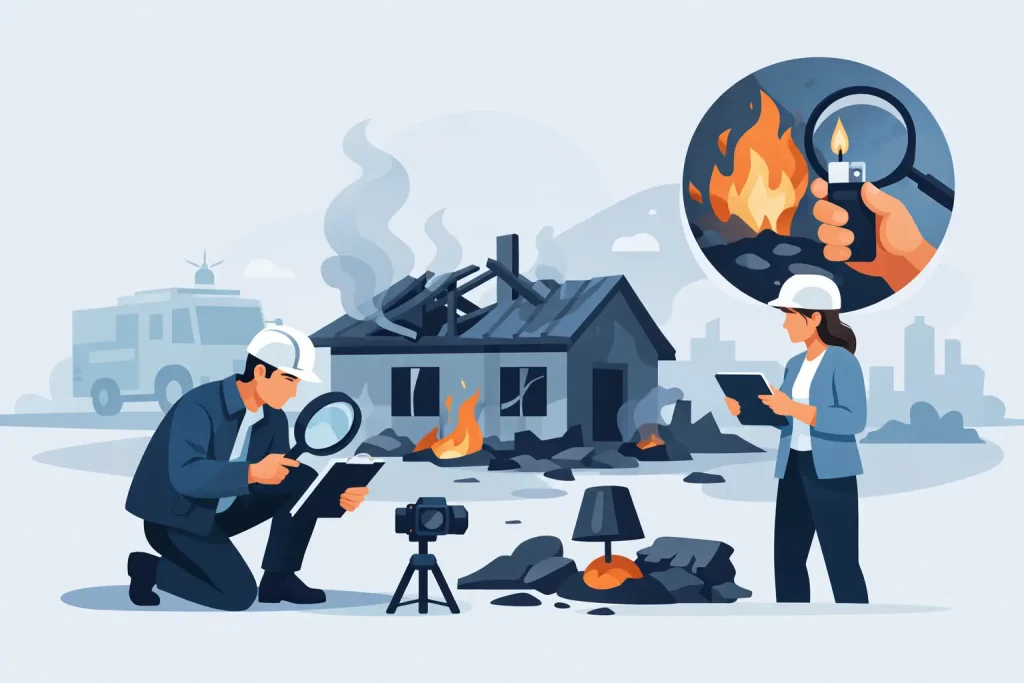
The telephone rarely rings with good news when fire is involved. By the time a loss adjuster is instructed, somebody has lost a stockroom, a kitchen, a workshop, a family room, or quite often their peace of mind. That is where understanding how loss adjusters investigate fires becomes more than idle curiosity. It explains why the questions can feel relentless, why the site visit looks half detective work and half diplomacy, and why a fire claim is never just about blackened walls and a smell of smoke.
How loss adjusters investigate fires in the real world
From the outside, people often imagine a rather theatrical scene – one person in a hard hat poking about in ashes and pronouncing judgement. Real life is less dramatic and far more methodical. A fire investigation for insurance purposes is usually about three things running at once: cause, policy response and value of the loss. If one of those strands is ignored, the whole claim can wobble.
The adjuster starts with the basics. What happened, when did it happen, who discovered it, who called the fire brigade, and what was happening at the premises in the hours before the blaze? These are not filler questions. The timeline matters because fires have habits. A blaze that starts during trading hours in a busy commercial unit raises different issues from one discovered at 3 am in an empty building with the alarm mysteriously silent.
Then comes the scene itself. Before anybody gets too carried away with theories, the adjuster wants to see the property as close to its post-fire condition as possible. Fire damage is untidy, but it is not random. Burn patterns, smoke deposits, areas of deepest char, collapsed sections and heat distortion all help build a picture. The adjuster is not pretending to be a forensic scientist unless he actually is one. Rather, he is gathering enough evidence to know whether a specialist fire investigator is needed, and whether the insured’s account sits comfortably with what the building is saying.
The first site visit is part evidence, part common sense
A good first visit has a rhythm to it. Safety comes first, because no insurance claim improves when the adjuster falls through a weakened floor. After that, the inspection tends to move from the least damaged areas towards the seat of the fire, if that can be identified.
At a domestic property, attention may fall on the kitchen, consumer unit, utility room or any area with heaters, chargers and appliances. In commercial premises, the list grows longer. Machinery, extraction systems, electrical installations, flammable liquids, hot works, smoking arrangements, refuse storage and security all come into play. A small factory can offer more possible ignition sources than a pub conversation offers opinions.
Photographs are taken in abundance. Notes are made about doors and windows, alarm systems, stock levels, housekeeping, maintenance records and anything else that may later become significant. The adjuster will also want to know what has already been removed. Sometimes the clean-up begins too quickly, often with the best of intentions, and key evidence disappears into a skip before anyone has had a proper look at it.
This is also the stage where witness accounts are gathered. The policyholder’s version is important, but so are comments from staff, neighbours, managing agents and attending contractors. Witnesses can be wonderfully helpful or magnificently confused. Smoke, panic and time have a way of rearranging memories. A careful adjuster listens politely, records accurately and treats early certainty with a little suspicion.
Cause is important, but so is policy liability
People tend to assume the whole job turns on one dramatic question: what caused the fire? That certainly matters, but insurance claims are rarely solved by a single revelation. Even where the cause appears accidental, the adjuster still has to consider whether the policy covers the loss, whether conditions were complied with and whether any underinsurance, excesses or exclusions apply.
Take a commercial claim involving a spray booth, for example. If the fire appears to have started within extraction ducting clogged by poor maintenance, the cause may be straightforward enough. The harder questions may sit elsewhere. Were risk protections required by insurers actually in place? Was the business using the premises in the way disclosed when cover was arranged? Had hazardous processes expanded without anybody troubling to mention it? Fires have a nasty habit of exposing paperwork weaknesses as efficiently as they expose wiring faults.
At domestic level, the issues can be different but no less awkward. A fire in a let property may raise questions about occupancy, security, condition and whether the insurer was told the house was tenanted at all. What looks like a simple blaze can quickly become a policy interpretation exercise with soot on it.
Specialists often join the enquiry
This is where the public image of the lone adjuster really falls apart. Serious fire claims usually involve a small cast. Fire investigators may be instructed to determine origin and cause. Electrical engineers may examine appliances or installations. Forensic accountants may assess business interruption. Surveyors and building consultants may advise on reinstatement. If there is an injury element, lawyers may appear as well, which tends to brighten nobody’s afternoon.
The adjuster’s role is to pull these threads together. He is not merely collecting reports like a librarian with a headache. He has to test whether the findings fit the facts, whether the costs claimed are reasonable, and whether the overall account makes sense commercially and practically.
That coordination matters because experts can be brilliant within their own lanes while missing the wider picture. A fire investigator may identify the area of origin, but not what the destroyed stock was worth. An accountant may quantify lost turnover, but not appreciate that the business was already struggling before the fire. The adjuster stands in the middle, trying to stop one part of the claim running ahead of another.
How loss adjusters investigate fires where fraud is suspected
Most fire claims are genuine. That should be said plainly. Yet insurers would be foolish to ignore the occasional case where the facts smell wrong even before the smoke has cleared. Fraud concerns do not always mean arson by the insured. They may involve exaggerated stock losses, invented contents, manipulated turnover figures or convenient gaps in records.
The warning signs are rarely as melodramatic as fiction suggests. They are often small inconsistencies. The insured says the premises were locked and alarmed, but alarm records suggest otherwise. Stock supposedly destroyed in the blaze had not been purchased in those quantities. A business claiming for booming trade cannot produce VAT returns that support the story. A homeowner reports the destruction of high-value items with no receipts, no photographs and no sensible explanation of where they came from.
None of that proves dishonesty on its own. People lose records in fires. They forget details. They estimate badly under stress. But a seasoned adjuster knows when to stop nodding sympathetically and start checking. That may mean analysing bank statements, supplier invoices, maintenance logs, phone records, CCTV, keyholder details and prior claims history. Fraud investigations are not about theatrics. They are about patient comparison between what is said and what can be evidenced.
The value of the claim can be harder than the cause
Oddly enough, once origin and policy response are broadly understood, the fiercest arguments often concern money rather than fire science. Building reinstatement costs can climb quickly when demolition, drying, decontamination and compliance with current regulations are factored in. Contents and stock claims bring their own disputes over age, condition, ownership and basis of settlement.
Business interruption is where the numbers become especially lively. A fire may close a premises for months, but the true financial impact depends on the type of business, seasonal trade, available alternatives and how quickly operations can be moved elsewhere. Some firms are remarkably resilient. Others are one missed month away from serious trouble. The adjuster has to separate genuine loss from hopeful arithmetic.
This part of the job requires tact as much as technical skill. Policyholders are often exhausted by the time value is being discussed. They may feel that proving the fire happened ought to be enough. From their perspective, every further request for accounts, invoices or stock schedules can look like obstruction. From the adjuster’s perspective, paying unsupported figures is not compassion. It is negligence wearing a friendly face.
Why fire investigations take time
People understandably ask why a fire claim cannot be sorted within days. The short answer is that burned buildings do not produce tidy evidence. Access may be restricted by safety concerns. The fire brigade report may take time. Specialist testing may be needed. Contractors, brokers, insurers and policyholders may all be waiting on one another. Meanwhile, the adjuster is trying to keep the claim moving without making premature decisions that later unravel.
The best adjusters explain this rather than hiding behind jargon. A good claim is not simply one that is settled quickly. It is one that is settled fairly, with the cause properly understood, the policy correctly applied and the amount paid standing up to scrutiny.
That may not sound glamorous, but then neither is standing in a wet, smoke-stained warehouse at half past seven on a February morning, trying to work out whether the fire started in the electrics or in someone’s imagination. Still, it is fascinating work for those who enjoy the mix of evidence, people and pressure. If you want a fuller taste of that world, The Perils of a Loss Adjuster exists for exactly that reason. Behind every fire claim is a story, and not always the one first told over the telephone.
Perhaps that is the most useful way to look at it. Fire destroys quickly, but understanding what really happened takes patience, scepticism and a surprisingly steady nerve.